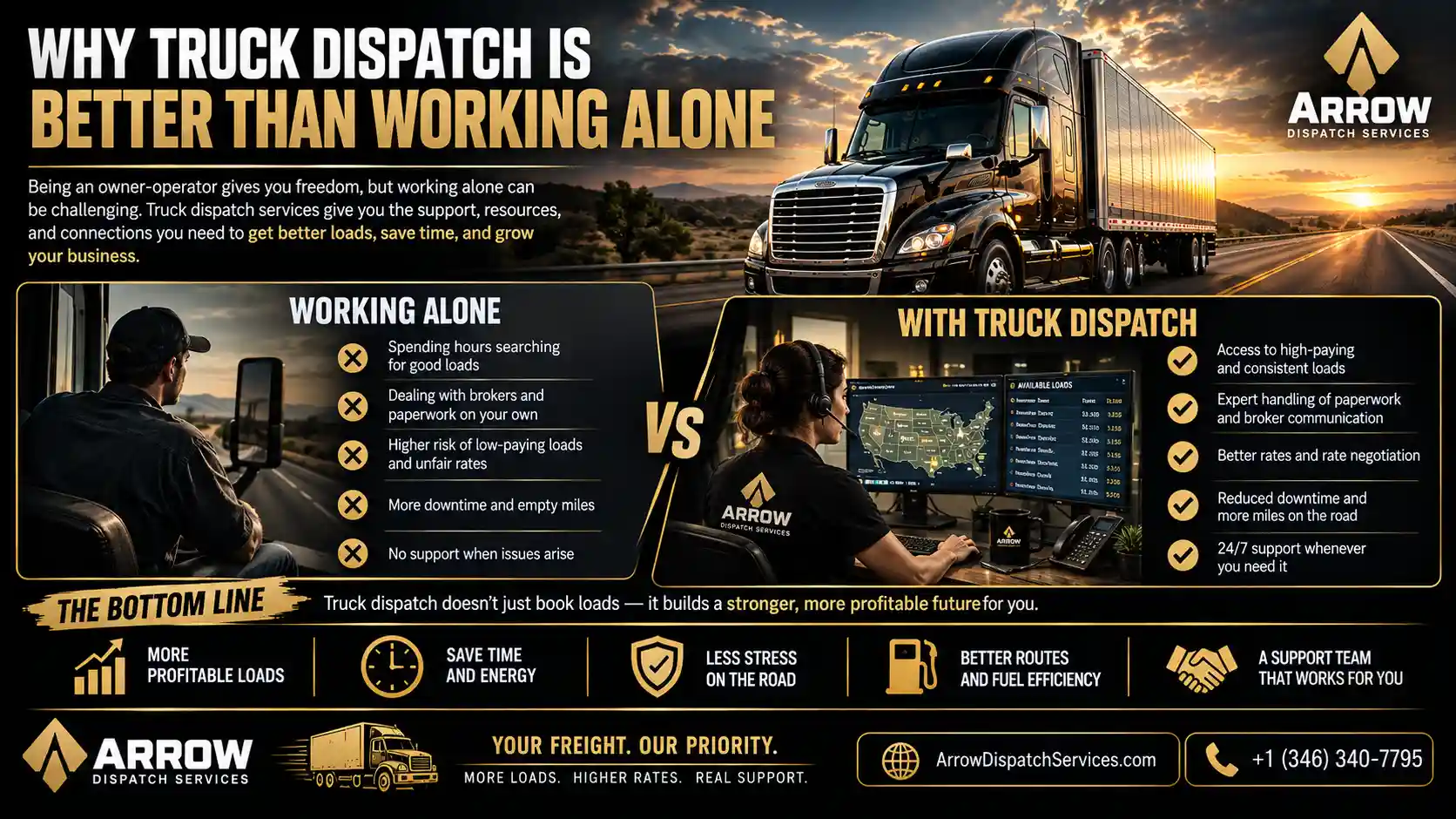
Running a trucking business alone gives an owner-operator complete control, but it also means handling almost every part of the operation. Finding loads, calling brokers, negotiating rates, checking paperwork, planning routes, tracking appointments, and searching for the next load can quickly take up a large part of the day.
Truck dispatch services can take many of these freight-related tasks off the owner’s plate. Instead of spending hours searching for loads and dealing with brokers, the owner-operator can focus more on driving, truck maintenance, compliance, and managing the business.
That does not mean dispatching is automatically the right choice for every carrier. The value depends on the carrier’s workload, freight situation, costs, and business goals. For owner-operators who find dispatch work difficult to manage alone, professional dispatch support can provide a more organized way to handle freight.
What Does Working Alone Mean for an Owner-Operator?
When an owner-operator works without dispatch support, they usually handle their own freight coordination.
This may involve:
- Searching load boards
- Calling brokers
- Negotiating rates
- Checking load details
- Planning routes
- Managing pickup and delivery schedules
- Handling rate confirmations
- Organizing proof of delivery
- Searching for the next load
- Following up on detention
These tasks are manageable for some carriers. However, as the number of loads increases, the administrative workload can become difficult to balance with driving.
What Does a Truck Dispatcher Handle?
A truck dispatcher typically works with a carrier to manage freight-related activities. The exact service depends on the agreement.
Common responsibilities may include:
- Finding available loads
- Comparing freight options
- Contacting brokers
- Negotiating rates
- Reviewing load information
- Coordinating pickup and delivery details
- Helping organize paperwork
- Monitoring upcoming freight
- Searching for reload opportunities
The carrier generally remains involved in approving loads and making important business decisions.
1. Less Time Searching for Loads
Searching for freight can take hours, especially when the carrier checks several load boards and contacts multiple brokers.
A dispatcher can handle this process and narrow down options based on the carrier’s requirements.
Instead of scrolling through hundreds of listings, the owner-operator can review suitable options and decide which load fits the operation.
This can make the daily routine more efficient.
2. More Time to Focus on Driving
An owner-operator already has a demanding job behind the wheel.
Trying to search for freight or negotiate with brokers while managing a trip can create unnecessary distractions.
With a dispatcher handling many freight-related calls and messages, the driver can focus on operating the truck safely.
This separation between driving and freight coordination can make the workday easier to manage.
3. Help With Rate Negotiation
Working alone means the owner-operator has to negotiate every rate personally.
A dispatcher can communicate with brokers and ask about rate flexibility based on factors such as mileage, deadhead, appointment times, equipment requirements, and market conditions.
A dispatcher cannot guarantee a higher rate, but having someone dedicated to freight negotiations can save time and create a more consistent process.
4. Better Load Comparison
A load should not be judged only by its advertised gross rate.
Carriers should consider:
- Total miles
- Loaded miles
- Deadhead
- Fuel costs
- Tolls
- Pickup and delivery times
- Number of stops
- Destination
- Next-load opportunities
A dispatcher can compare these factors when presenting freight options.
This can help the owner-operator make decisions based on the complete trip rather than one number.
5. Reduced Deadhead Planning
Deadhead miles cost money without generating loaded revenue.
When working alone, the carrier has to consider how far the truck must travel empty to reach the next pickup.
A dispatcher can factor the truck’s current location into the load search and look for freight that reduces unnecessary repositioning.
Deadhead cannot always be avoided, but better planning can help control it.
6. Help Finding the Next Load
One common challenge of working alone is finishing a delivery and then starting the load search again.
A dispatcher can begin looking for the next load before the current shipment is delivered.
This allows the carrier to consider potential reloads based on the expected destination.
The next load is never guaranteed, but planning ahead can reduce the amount of time spent sitting without freight.
7. Less Broker Communication
Brokers may contact carriers about pickup information, tracking, appointment changes, rate confirmations, delivery updates, and other details.
Handling every communication personally can become time-consuming.
A dispatcher can serve as the communication point for many freight-related conversations.
This allows the driver to spend less time answering calls and messages while working.
8. Paperwork Support
Freight paperwork can be another source of administrative work.
Depending on the dispatch agreement, a dispatcher may help organize documents such as:
- Rate confirmations
- Bills of lading
- Proof of delivery
- Lumper receipts
- Detention records
Keeping documents organized can make the billing and record-keeping process easier.
Carriers should confirm exactly what paperwork support is included before signing a dispatch agreement.
9. More Organized Freight Planning
Working alone can sometimes lead to reactive decisions. A truck becomes empty, and the owner immediately looks for whatever freight is available.
A dispatcher can take a broader view by considering the current load, delivery location, preferred lanes, and possible next moves.
This does not guarantee better revenue, but it can create a more structured freight planning process.
10. Support for Different Equipment Types
Freight requirements vary by equipment.
Dry vans, reefers, flatbeds, step decks, box trucks, hotshots, and power-only trucks operate in different markets.
A dispatcher familiar with the carrier’s equipment can search for loads that match its capabilities.
This can save the owner-operator time by filtering out freight that is unsuitable for the truck.
11. Better Use of Business Time
An owner-operator has more responsibilities than finding freight.
Time may also be needed for:
- Truck maintenance
- Fuel planning
- Compliance
- Accounting
- Insurance
- Expense tracking
- Customer communication
- Business development
When a dispatcher handles freight coordination, the owner can use some of that saved time for other parts of the business.
12. Help With Detention Follow-Up
Truck delays at shippers and receivers can create additional work.
When applicable, the carrier may need to document arrival and departure times and contact the broker about detention.
A dispatcher can assist with this communication and follow up on the request.
Whether detention is paid depends on the applicable load agreement and broker or shipper policy.
13. Access to More Freight Opportunities
A dispatcher may monitor multiple load sources and communicate with different brokers.
This can give the carrier a broader search process than relying on a single source.
The quality and availability of freight will still depend on the market, equipment, location, and timing.
A larger search does not guarantee a high-paying load, but it can provide more options to evaluate.
14. Less Administrative Stress
Freight management involves many small tasks.
One phone call may turn into a rate confirmation, appointment update, tracking request, paperwork issue, and follow-up message.
Handling these tasks every day can become exhausting for an owner-operator.
Delegating part of this workload can make the business side of trucking easier to manage.
15. More Focus on Long-Term Business Goals
When an owner spends most of the day dealing with immediate freight problems, long-term planning can get pushed aside.
Dispatch support can create more time to think about:
- Adding another truck
- Improving equipment
- Reducing operating costs
- Building broker relationships
- Planning home time
- Improving cash flow
- Growing the customer base
The dispatcher handles freight coordination while the owner can spend more attention on the bigger picture.
Is Truck Dispatch Always Better Than Working Alone?
Not necessarily.
Some experienced owner-operators prefer handling their own dispatch because they already have broker relationships, direct customers, preferred lanes, or enough experience to manage freight efficiently.
Others may find that dispatching takes too much time and interferes with driving or business management.
The decision depends on the individual carrier’s operation.
The important question is whether the time, cost, and effort required to manage freight alone make sense for the business.
What Does a Good Dispatch Arrangement Look Like?
A good dispatch arrangement should have clear responsibilities.
Before hiring a dispatcher, an owner-operator should understand:
- How loads are sourced
- How rates are negotiated
- Who approves loads
- What equipment the dispatcher understands
- What paperwork is handled
- How broker communication works
- How fees are calculated
- Whether there are additional charges
- How cancellation works
- What happens if the carrier rejects a load
Clear expectations can prevent problems later.
How Much Does Truck Dispatch Cost?
Truck dispatch pricing varies between service providers.
Some dispatch companies charge a percentage of gross revenue, while others use a flat fee or another pricing model.
Instead of comparing price alone, carriers should look at what the service actually includes.
A lower fee may not provide the same level of support as a more comprehensive service.
The carrier should calculate whether the time saved and services received justify the cost.
How to Know if Dispatch Support Is Helping
Carriers can track results before and after hiring a dispatcher.
Useful measurements include:
- Weekly gross revenue
- Revenue per total mile
- Deadhead percentage
- Number of loads
- Time between loads
- Hours spent searching for freight
- Fuel costs
- Detention recovered
- Administrative hours
These numbers provide a clearer picture of whether dispatch support is improving the operation.
Common Problems With Working Alone
Working alone can create several challenges when the workload becomes too large.
Too Much Time on Load Boards
Constantly searching for freight can take time away from driving and business management.
Missed Opportunities
An owner-operator may miss suitable freight while driving, sleeping, or handling another load.
Difficult Rate Negotiations
Negotiating every load personally can become repetitive and time-consuming.
Poor Reload Planning
Waiting until delivery to search for the next load can increase idle time.
Administrative Overload
Paperwork, broker calls, and tracking updates can accumulate quickly.
Final Thoughts
Truck dispatch services can be useful for owner-operators who want to reduce the amount of time spent handling freight coordination alone. A dispatcher can help with load searching, broker communication, rate negotiation, paperwork, route planning, and reload planning.
The biggest advantage is not a promise of higher revenue. It is having dedicated support for tasks that can take valuable time away from driving and running the business.
Working alone may still make sense for carriers with strong broker relationships, direct freight, or enough time and experience to manage dispatch efficiently.
For those considering a dispatcher, the best approach is to compare the actual workload, dispatch costs, services provided, and business needs. A clear agreement can help the carrier maintain control while getting support where it is most useful.
FAQs
Why do owner-operators hire truck dispatchers?
Many owner-operators hire dispatchers to save time on load searching, broker communication, rate negotiation, paperwork, and freight planning.
Can a dispatcher guarantee higher revenue?
No. A dispatcher cannot guarantee a specific revenue level or rate. Freight availability, market conditions, equipment, location, and timing all affect earnings.
Does a dispatcher choose loads for the carrier?
A dispatcher may search for and recommend loads, but the carrier’s agreement should clearly state who approves the final load.
Is dispatching difficult for owner-operators?
It can become time-consuming because it involves load searches, broker calls, rate negotiations, paperwork, and constant freight planning alongside driving.
Can dispatchers help reduce deadhead?
They can consider deadhead when comparing freight and planning the next move. However, some empty miles may still be unavoidable.
Do dispatchers negotiate rates?
Many dispatch services negotiate freight rates with brokers on behalf of carriers. Results depend on the specific load and market conditions.
Is truck dispatch worth the cost?
It depends on the carrier’s workload, dispatch fees, freight situation, and business goals. Tracking time and operating results can help determine whether the service provides value.
What should I ask before hiring a dispatcher?
Ask about fees, load sourcing, rate negotiation, paperwork, broker communication, load approval, equipment experience, contract terms, and cancellation policies.
Can experienced owner-operators still benefit from dispatch services?
Yes, if dispatch tasks take time away from other business responsibilities. However, an experienced carrier with strong direct customers or broker relationships may prefer to continue handling dispatch independently.