Why Most Truck Dispatch Businesses Fail
It may seem easy to set up a truck dispatch business. You do not need vehicles, gas, or chauffeurs. All you need is a laptop, load boards, and a bit of industry knowledge. And that is why so many get into it–and why the greatest part of them fail.
It is not the opportunity that is the problem. Truck dispatching may pay off. How individuals take care of it is the issue. They take it as a shortcut rather than a business.
In case you wish to make anything that would last, you must know where others fail.
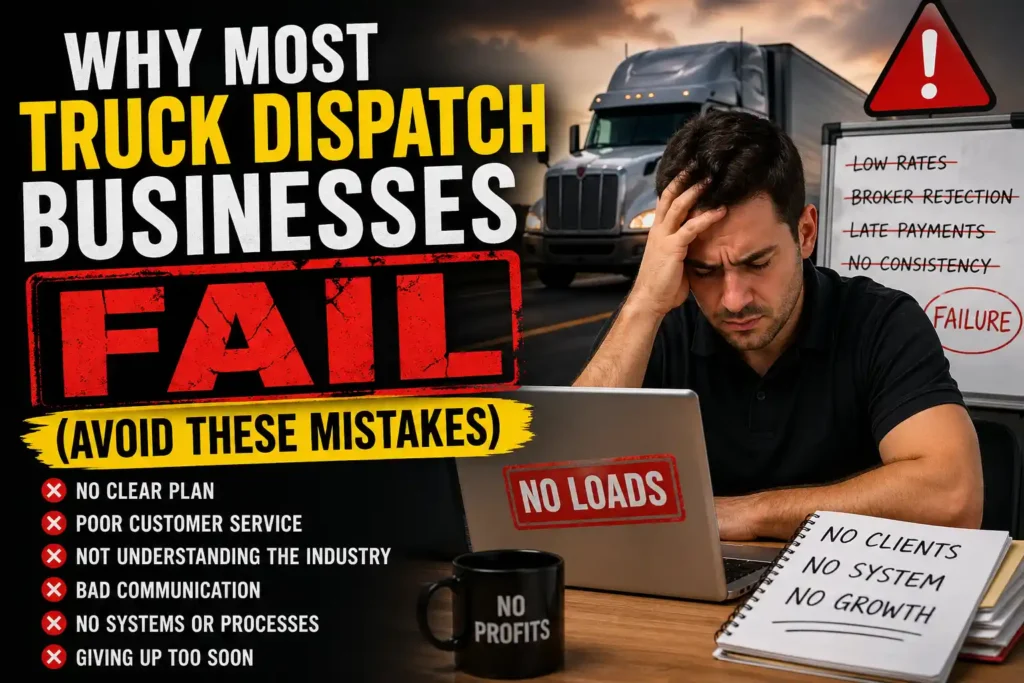
They Start Without Understanding the Industry
Many new dispatchers are jumping in after viewing some YouTube tutorials or purchasing a low-cost course. They are aware of how to make a load, but not how the trucking business really operates.
They don’t understand:
- Rate cycles
- Broker behavior
- Seasonal demand
- Driver challenges
- Compliance basics
So when the expected does not happen, the rates decline, brokers push sell, drivers complain, and they get panicked.
Dispatching does not simply entail the location of loads. It involves deciding on issues that can impact the business of another. Unless you see the whole picture, you will be afraid to trust.
Remedy: Take time to understand the industry. Read the market trends, Interviews with drivers and how money moves in the trucking industry.
Chasing Too Many Clients Too Fast
Novices believe that more clients are equated with more money. So they bring on board as many owner-operators as they can manage.
Then reality hits.
They can’t:
- Communicate properly
- Seek regular loads among all.
- Deal with various preferences and aisles.
Service quality drops. Drivers get frustrated. Some leave. There are others who no longer believe you.
This does it in a circle of constantly losing customers instead of expanding.
Fix: Start small. The initial number of 1-2 clients suffices. Be concentrated on producing good results. Consistency should be followed by growth.
Poor Communication with Drivers
Dispatching is a relationship business. When communication fails, all goes terribly wrong.
Common mistakes include:
- Failure to update drivers in a timely manner.
- Ignoring telephone calls or text messages.
- Failure to give the reasons behind some loads.
- Overpromising and underdelivering
Drivers do not simply require loads. They need clarity. They must be made to feel that somebody is running their business in the right manner.
They will get away, no matter the quantity of loads you reserve–they will walk if they feel neglected or puzzled.
Fix: Be responsive. Be honest. Bad news is preferable to no news.
Focusing Only on Booking Loads
A large number of dispatchers believe that their work is complete after offering a load. Mistakenly large.
Real dispatching includes:
- Negotiating rates
- Planning routes
- Dealing with layovers and detention.
- Handling broker issues
- Profitable, not busy drivers.
Chasing loads will leave you with burning drivers on low-paying or inefficient loads.
Busy is not profitable.
Fix: Be able to think as a business partner, not only as a load booker. Each of them must enhance the earnings and efficiency of the driver.
Weak Negotiation Skills
New dispatchers tend to take any rate they are given. They fear bargaining or are not aware.
This leads to:
- Reduction in profits to drivers.
- Lower self-confidence.
- Difficulty retaining clients
Every day, brokers negotiate. In case you fail to push, you are leaving money on the table.
Fix: Understand how to negotiate. Be aware of the market rate, put your case forward and do not immediately accept the first offer.
No Clear System or Process
Chaos is the way many dispatch businesses operate. No structure. No systems. All is by hand and responsive.
This causes:
- Missed loads
- Double bookings
- Poor tracking
- Stress and burnout
You cannot scale without systems. You will never get out of doing everything yourself.
Fix: Develop straightforward processes:
- Load tracking sheets
- Communication routines
- Daily checklists
- Basic CRM tools
The structure is time-saving, and mistakes are minimized.
Ignoring Legal and Compliance Basics
Certain dispatchers do not even bother to learn the limits of the law. Without proper authority, they confuse dispatching and brokerage business operations.
This is capable of causing severe issues.
Also, they don’t:
- Use proper agreements
- Be clear in terms of service.
- Protect themselves legally
This results in conflicts, non-payments and risk.
Fix: Maintain cleanliness in your business. Use agreements. Keep inside the legal limits of dispatching. And never know it [without researching it well].
Unrealistic Income Expectations
One of the main reasons why some people give up is simple: they want to make a quick buck.
They listen to things such as:
- earn thousands in the first month
- “No experience needed”
- “Passive income”
It is not that way.
It takes time to build a stable dispatch business:
- Finding clients
- Earning trust
- Learning the market
- Fixing mistakes
You will soon become frustrated if you demand instant results.
Fix: This should be like a real business. Think long term, not short term.
Poor Client Selection
Not all drivers fit in. Made youngsters tend to believe anybody.
This causes such issues as:
- Indisciplined drivers.
- Unrealistic expectations
- Payment issues
- Constant complaints
A single bad customer will consume more time than three good ones.
Fix: Be selective. Cooperate with serious, professional and cooperative drivers.
No Long-Term Vision
A high percentage of dispatchers work on a day-to-day basis without a look ahead.
They don’t plan:
- Scaling strategy
- Hiring support
- Expanding services
- Building a brand
Therefore, they may make some money, but the business remains stagnant.
At some point, they get burnt or lost.
Fix: Think long-term. In a year, where would you like this business to be? Gradually build up to that.
Conclusion
Truck dispatching is no short-course business. It is a service company that relies on trust, regularity, and genuine knowledge.
The majority of people fail to do it in a casual manner. They undervalue the labor, overvalue the profits, and are disrespectful of the basics.
In the case of owner operators in the USA, it is more difficult to find steady and well-compensated loads than the actual driving of the truck. The competition is intense, the brokers are quick, and any good freight will hardly have a lengthy shelf life. Here is where dispatch services are involved. An experienced dispatcher could save some money, lessen dead air miles and enable you to drive more rather than drive all day trying to locate loads.
This guide defines exactly what truck dispatch services are, why they are important to owner operators and how to select the one that fits best in your trucking industry.
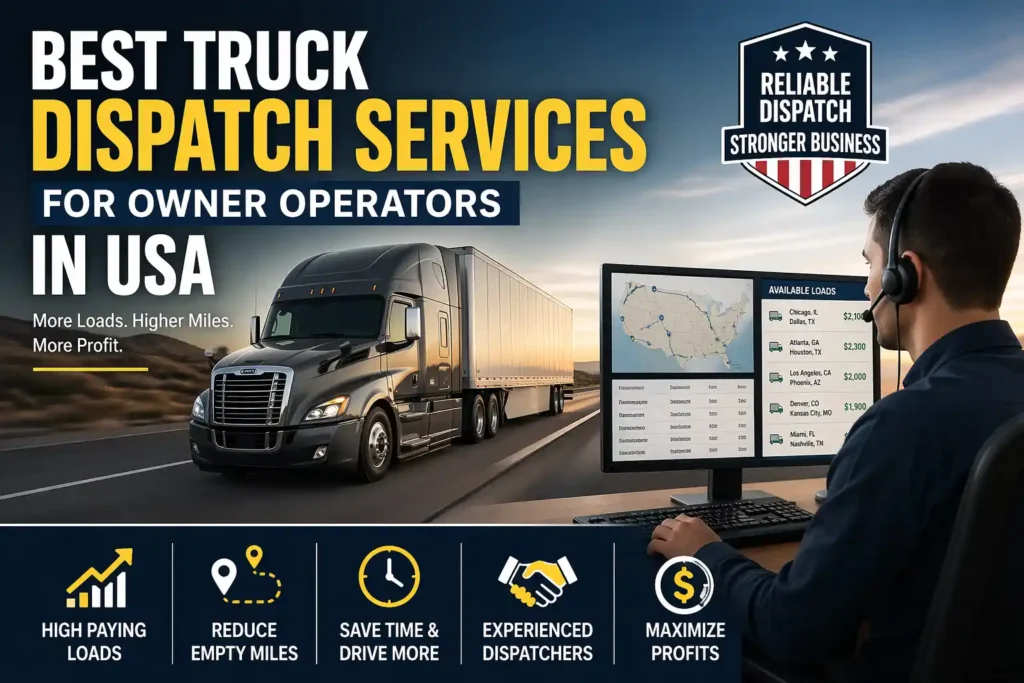
What is a truck dispatch service?
A truck dispatch service is a support service that assists truck drivers and owner operators with locating freight loads and securing them. Tasked with searching, negotiating, and making bookings, dispatchers are no longer using hours in load boards.
They have a straightforward occupation:
-
- Find available loads
-
- Contact brokers
-
- Negotiate rates
-
- Freight by truck your books.
-
- Handle basic paperwork
Simply put, they are intermediated, drivers and freight brokers.
Why owner operators need dispatch services
A lot of owner operators begin by thinking that they can do it all on their own. However, in the long run, the majority of them realize that it is a full-time job to find regular loads.
This is the actual use of dispatch services:
Saves time
You do not need to search loads all day, but instead you will be able to focus on driving and deliveries.
Better load access
Direct broker connections are often not available publicly on load boards and can only be provided by dispatchers.
Higher earning potential
An experienced dispatcher will think of how to get better freight rates.
Reduced empty miles
Fractionate dispatching makes you get backloads and limits deadhead movements.
Consistent work
Rather than random loads, you have more stable weekly routes.
What makes a good dispatch service?
Dispatch services are not all alike. Some are professional, seasoned, and others are mere novice load finders.
In a good dispatch service, we should find:
-
- Strong broker network
-
- Freight experience in various kinds.
-
- Clear communication
-
- Transparent pricing
-
- Skill in locating well-paying loads.
-
- Fixed assistance for your type of truck.
When a dispatcher cannot regularly supply loads, then what is the point?
Types of dispatch services for owner operators
This is because various trucks demand varying forms of dispatch support.
Box truck dispatching services.
Purposely used in Amazon relay and local freight, focused on local and regional delivery loads.
Flatbed dispatch services
Specializes in heavy and oversized freight like construction materials and equipment.
Hotshot dispatch services.
Pickup trucks with trailers are used to load fast delivery loads, which may be time-sensitive freight.
Reefer dispatch services
During the transportation of products under a certain temperature (food and pharmaceuticals).
Dry van dispatch service.
One of the most prevalent ones is transporting general freight interstate.
How dispatch services help increase profits
A good dispatching service is not one that simply locates loads. It has a direct effect on your income.
They help by:
-
- Finding higher-paying lanes
-
- Avoiding low-rate brokers
-
- Planning efficient routes
-
- Reducing fuel waste
-
- Booking backhaul loads
A single percent change in rate per mile can result in a huge rise in monthly earnings.
Common mistakes owner operators make
Too many drivers can not work not due to the absence of work, but due to the miscalculations:
-
- Taking low loads too readily.
-
- Collaborations with inexperienced dispatchers.
-
- Using a single source of load.
-
- Failure to plan the return trips.
-
- Not considering fuel and route efficiency.
These are some of the mistakes that should be avoided to contribute significantly to profitability.
How to choose the best truck dispatch service in USA
Check: Before working with any dispatch company, examine:
Experience
The length of time that they have been in the trucking industry.
Load network
The existence of strong relationships with brokers and shippers.
Transparency
Proper definition of fees and commission system.
Communication
Quick reaction and adequate movement updates on loads.
Results
Potential to supply regular and lucrative loads.
Conclusion
A good dispatch service is more than a support tool to owner operators in the USA: it can be a business partner. It not only curbs downtime but also improves the quality of loads and overall profits.
The thing, though, is selecting the appropriate dispatcher. One feeble service will cost you time, and a good one will always get your truck going and make you a profit.
Assuming that you want consistent traffic and improved revenues, then one of the most efficient dosses that you can take in the trucking sector is to engage a solid dispatch service.