Fuel tax is among the two most misunderstood but most operationally sensitive cost centers in trucking.
Fuel tax reporting, when you are an owner-operator of multi-state lanes, has a direct impact on:
- Profit per mile
- Audit exposure
- Cash flow timing
- Compliance risk
The International Fuel Tax Agreement (IFTA) was developed to ease the burden of the fuel reporting process across multiple jurisdictions – yet it does not relieve responsibilities. IFTA filings, if not done properly, can result in penalties, audits, and unexpected back payments.
Let’s define what IFTA is, who needs it, and why it should be important for your trucking company.
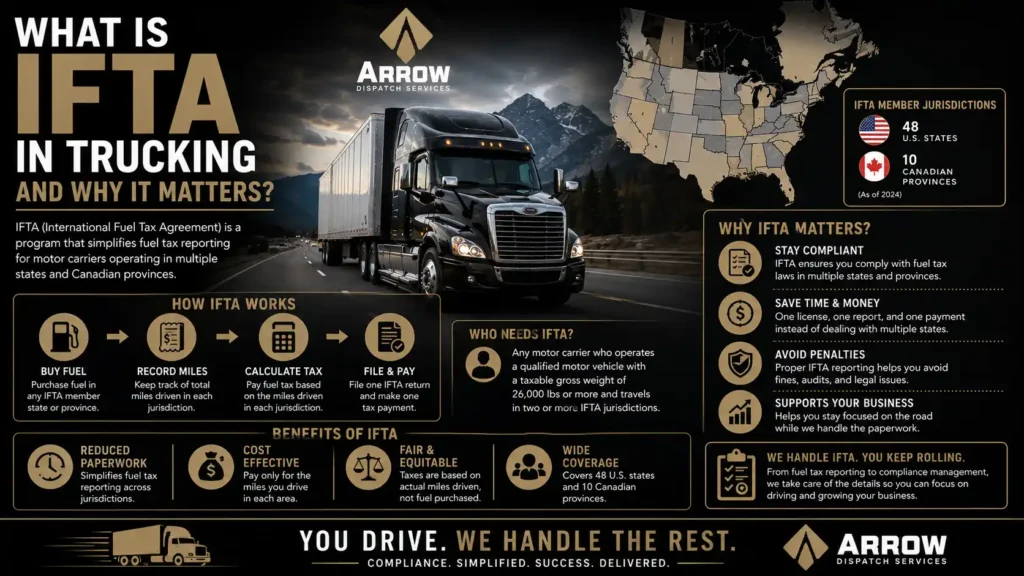
What Is IFTA Tax? A Brief Overview
IFTA is an acronym for the International Fuel Tax Agreement. This is an accord between the United States of America and Canada that permits carriers and logistics service providers that provide service in both countries to do so without obtaining a separate fuel tax licence.
This agreement does not apply to the entire United States, nor to all of Canada. Rather, it is the Lower 48 states in the US and 10 Canadian Provinces and territories that are covered. Carriers and logistics professionals who travel between these states and provinces, including those traveling over the international border, pay their fuel tax directly to the state or province from which they are operating. Although each state and province continues to receive its own cut, the owner-operators and drivers are not required to fill out complex fuel tax returns for crossing each State line – or any other jurisdictional line, for that matter.
The agreement is crafted to save time, money, and effort. As a result, it also plays some part in levelling up local economies, as with this agreement, it is not envisaged to stifle the operation of logistics and haulage companies.
Which Areas Are Covered Under the IFTA?
Ten states and provinces in Canada are part of the International Fuel Tax Agreement (as mentioned above). These are:
- Alberta;
- British Columbia;
- Manitoba;
- New Brunswick;
- Newfoundland and Labrador;
- Nova Scotia;
- Ontario;
- Prince Edward Island;
- Quebec;
- Saskatchewan.
In fact, every driver/logistics company is covered in all parts of Canada, except for the three northwestern territories of Yukon, the Northwest Territories, and Nunavut.
The list is even more extensive for the USA. The IFTA will save time and money for drivers and logistics companies in all of the lower 48 states. The only jurisdictions NOT covered by IFTA are as follows:
- The IFTA does NOT apply to Alaska.
- The IFTA does NOT apply in Hawaii.
- The IFTA does NOT apply to the District of Columbia.
- ALL OTHER states ARE covered under the IFTA.
IFTA is not a way to get rid of the fuel tax. It centralizes reporting. Carriers continue to be liable for taxes on mileage within each jurisdiction (even if fuel was bought outside the jurisdiction).
IFTA is mainly restricted to vehicles operating under federal safety oversight by the FMCSA safety audit program and are classified in commercial motor vehicle categories.
The History of the IFTA
Like many other agreements and cooperations, the International Fuel Tax Agreement has arisen and prospered with a friendly relationship between Canada and the US. As with many legal and political arrangements between the two countries, IFTA originated from a very specific need – in this case, the need to collect fuel tax, without hurting the business of owner/operators and drivers in the logistics industry.
Each year, millions of tons of freight cross back and forth across the US-Canadian border. But that isn’t the only border that the freight has to traverse; this freight is a major contributor to both North and South economies and societies! Because of the federal systems of both the US and Canada, each individual state, province, or territory may have its own limits of taxation as well as its own rules. This causes trouble when trading goods with and from other countries and in logistics.
In other words, until the introduction of IFTA, drivers of freight vehicles had to apply for fuel permits for each state and territory they drove through. If the trip is, say, from New York State to Ontario, Canada, or Maryland to Pennsylvania, it does not cause too much hardship. But, often, this is not the case. Drivers can encounter ten or more state/provincial lines to reach their destination, especially in the Northeast in the US, where there are a greater number of state lines.
But the requirement for individual fuel permits to be applied for is problematic enough for logistics companies. But this is not enough, as there are a lot of other things to consider. The challenges facing drivers and organisations were:
- Variations between different state or provincial filing requirements and periods.
- Crucial differences in the state and provinces’ utilization of key legal and tax definitions.
- Different requirements apply to different things; some have fairly loose regulations, while others have more stringent requirements for reporting.
- Permit price disparity by States/Provinces.
Arguments that the process of filing differs by state and by province (in-person filing vs. online filing).
All these helped to fuel the skyrocketing prices for logistics companies. They not only had to pay for these extra permits, but they also had to use fuel to cover their distance to the permit processing centres, risk late delivery of their cargo because of permit infringement, and even lose out on business because of permit delays. It was a very negative situation indeed.
Since the IFTA, logistics companies and drivers find their lives and work a lot easier. Businesses are benefiting from lower administrative expenses – in some instances, thousands of dollars annually, and millions. That’s better for company bosses, drivers, and even customers and the public.
Do I Need an IFTA Sticker and License?
An IFTA fuel sticker for your trucks may not be necessary for all drivers or businesses. Basically, you will need an IFTA license and the proper decals if you meet the following criteria.
- You run a business vehicle or fleet of logistics.
- Vehicles you operate are qualified motor vehicles” per IFTA rules. This means:
- A motorized conveyance used to travel between places, carrying passengers or equipment
Motor vehicle which is in one of these classes: - There are 2 axles and more than 11,797 kg (or 26,000 lbs) of total weight – any vehicle with a weight over this limit will require an IFTA sticker.
- The vehicle is equipped with 3 or more axles (there is no weight category for this one).
- Your base is in any of the member country/state/province listed above.
- You do business in two or more of these member states or provinces.
Carriers that operate in regional or cross-border freight should consider how the operating structure can impact fuel tax exposure as critically as deciding to utilize OTR, regional, or local lanes.
How IFTA Impacts Owner-Operator Profitability
Independent operators don’t just have to deal with IFTA; they have to deal with margin math.
If you buy most of your fuel in situations where taxes are lower (or none) and use it much in places where taxes are higher, you could be liable for extra taxes at quarter turn-in.
An inability to keep records leads to:
- Estimated mileage assessments
- Audit penalties
- Interest charges
- Temporary suspension
IFTA compliance is administrative, but its impact is financial.
What Is IFTA License and How to Apply?
If you qualify your business as above, you will have to visually post an IFTA sticker on your vehicles and have a valid IFTA license for your business.
You will need to apply for your license and the stickers to signify that your vehicles are in accordance with IFTA requirements in the state or province in which your business is based. To apply, you must have a registered business name, a United States business mail address, a federal business number (FBN), and a USDOT number.
Where and how you file your application will depend on the state you operate in. Each year, you’ll have to renew your IFTA sticker to ensure the record of your IFTA status is current. The cost of IFTA stickers will be different from state to state and province to province.
Fuel tax reporting needs to be accurate, since it occurs in quarters. Things go haywire fast, particularly for those who operate across multiple states.
Owner operators & fleets are supported by Arrow Dispatch Services with:
- Accurate IFTA reporting
- Mileage reconciliation
- Fuel documentation review
- Compliance tracking
That’s a simple thing we set out to do as a professional dispatch service provider: minimize audit risk, maximize profits, and stay focused on your operations — not paperwork.
When you’re ready to secure your compliance structure, contact Arrow Dispatch Services today.
In the case of owner operators in the USA, it is more difficult to find steady and well-compensated loads than the actual driving of the truck. The competition is intense, the brokers are quick, and any good freight will hardly have a lengthy shelf life. Here is where dispatch services are involved. An experienced dispatcher could save some money, lessen dead air miles and enable you to drive more rather than drive all day trying to locate loads.
This guide defines exactly what truck dispatch services are, why they are important to owner operators and how to select the one that fits best in your trucking industry.
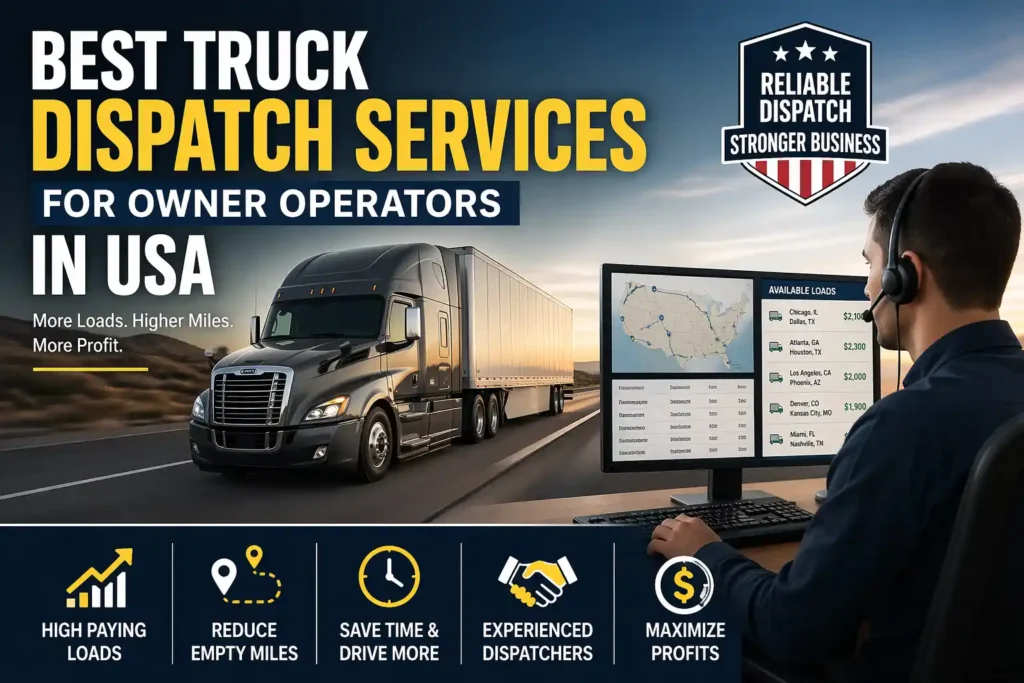
What is a truck dispatch service?
A truck dispatch service is a support service that assists truck drivers and owner operators with locating freight loads and securing them. Tasked with searching, negotiating, and making bookings, dispatchers are no longer using hours in load boards.
They have a straightforward occupation:
-
- Find available loads
-
- Contact brokers
-
- Negotiate rates
-
- Freight by truck your books.
-
- Handle basic paperwork
Simply put, they are intermediated, drivers and freight brokers.
Why owner operators need dispatch services
A lot of owner operators begin by thinking that they can do it all on their own. However, in the long run, the majority of them realize that it is a full-time job to find regular loads.
This is the actual use of dispatch services:
Saves time
You do not need to search loads all day, but instead you will be able to focus on driving and deliveries.
Better load access
Direct broker connections are often not available publicly on load boards and can only be provided by dispatchers.
Higher earning potential
An experienced dispatcher will think of how to get better freight rates.
Reduced empty miles
Fractionate dispatching makes you get backloads and limits deadhead movements.
Consistent work
Rather than random loads, you have more stable weekly routes.
What makes a good dispatch service?
Dispatch services are not all alike. Some are professional, seasoned, and others are mere novice load finders.
In a good dispatch service, we should find:
-
- Strong broker network
-
- Freight experience in various kinds.
-
- Clear communication
-
- Transparent pricing
-
- Skill in locating well-paying loads.
-
- Fixed assistance for your type of truck.
When a dispatcher cannot regularly supply loads, then what is the point?
Types of dispatch services for owner operators
This is because various trucks demand varying forms of dispatch support.
Box truck dispatching services.
Purposely used in Amazon relay and local freight, focused on local and regional delivery loads.
Flatbed dispatch services
Specializes in heavy and oversized freight like construction materials and equipment.
Hotshot dispatch services.
Pickup trucks with trailers are used to load fast delivery loads, which may be time-sensitive freight.
Reefer dispatch services
During the transportation of products under a certain temperature (food and pharmaceuticals).
Dry van dispatch service.
One of the most prevalent ones is transporting general freight interstate.
How dispatch services help increase profits
A good dispatching service is not one that simply locates loads. It has a direct effect on your income.
They help by:
-
- Finding higher-paying lanes
-
- Avoiding low-rate brokers
-
- Planning efficient routes
-
- Reducing fuel waste
-
- Booking backhaul loads
A single percent change in rate per mile can result in a huge rise in monthly earnings.
Common mistakes owner operators make
Too many drivers can not work not due to the absence of work, but due to the miscalculations:
-
- Taking low loads too readily.
-
- Collaborations with inexperienced dispatchers.
-
- Using a single source of load.
-
- Failure to plan the return trips.
-
- Not considering fuel and route efficiency.
These are some of the mistakes that should be avoided to contribute significantly to profitability.
How to choose the best truck dispatch service in USA
Check: Before working with any dispatch company, examine:
Experience
The length of time that they have been in the trucking industry.
Load network
The existence of strong relationships with brokers and shippers.
Transparency
Proper definition of fees and commission system.
Communication
Quick reaction and adequate movement updates on loads.
Results
Potential to supply regular and lucrative loads.
Conclusion
A good dispatch service is more than a support tool to owner operators in the USA: it can be a business partner. It not only curbs downtime but also improves the quality of loads and overall profits.
The thing, though, is selecting the appropriate dispatcher. One feeble service will cost you time, and a good one will always get your truck going and make you a profit.
Assuming that you want consistent traffic and improved revenues, then one of the most efficient dosses that you can take in the trucking sector is to engage a solid dispatch service.