When it’s cold enough, it’s not just the lack of comfort – when your diesel doesn’t start, you’re in trouble! You are wasting time, available spaces, and money. Cold-start failures are an issue at work—they result in missed pickups, risk of late deliveries, and unscheduled downtime.
Most no-starts in the winter can be avoided with the proper preparation (fuel, batteries, heaters, and maintenance), but when they are not, you require a clean troubleshooting sequence that can start your engine without harming it.
Why a Diesel Truck Won’t Start in Cold Weather
The major difference between diesel and gas-powered engines makes starting the diesel engine on colder days more difficult. Unlike petrol engines, in a diesel engine, air is compressed in the cylinder, and this air is used for ignition. In particular, the air has to be subjected to a compression, during which its volume is reduced by 16, and its temperature increased to 400 degrees, so that it will be able to be ignited upon injection in the combustion chamber. It goes without saying that colder temperatures will hinder this process; some of the reasons a diesel truck doesn’t always start in cold weather. Gasoline internal combustion engines, of course, use spark plugs to ignite gas. What is the lowest temperature that a diesel engine can run safely?
Diesel fuel will gel in cold weather, particularly when using №2 diesel fuel and poor additives. Around the mid-teens °F, problems begin to arise, based on blend, additives, and exposure, which is why winter fuel prep is important.
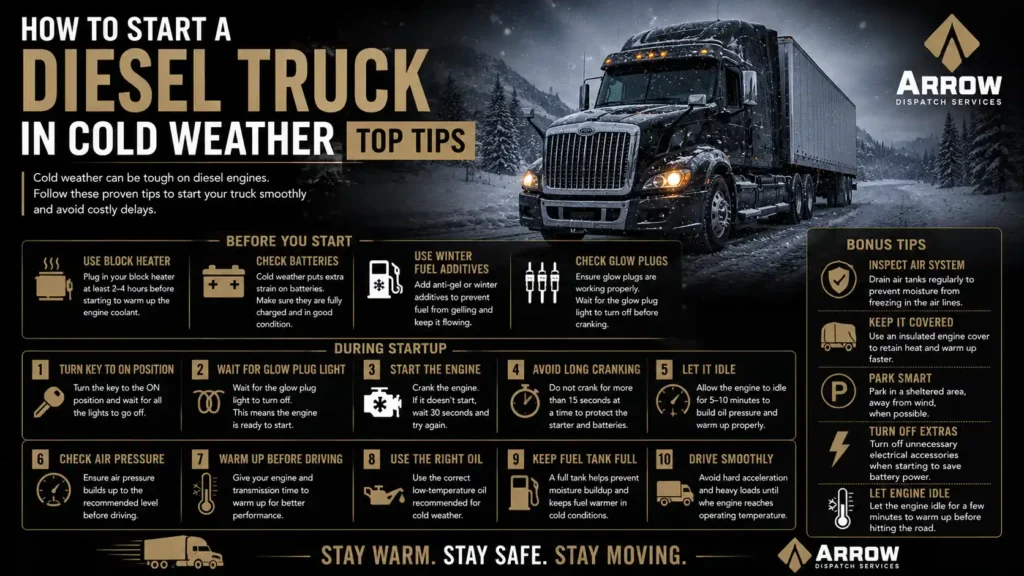
How to Start a Diesel Truck in Cold Weather
The key in terms of how to start a diesel truck in cold weather and provide cold cranking amps to start your diesel engine is being able to heat up the engine in order for the fuel to ignite. There are a number of things you can do to ensure that you can quickly get your diesel engine to temperature and save yourself time and aggravation. We will start with the three main engine heating methods, but also include a list of things to keep in mind – reduce downtime and restart risk, or have discovered during our years in business helping owner-operators of trucking businesses.
Heating Methods When You Have Trouble Starting a Diesel Truck
There are three most obvious ways to warm it up when it’s cold outside, and your diesel car or truck refuses to start: glow plugs, a block heater, and an intake heater. It’s a good idea to be familiar with your equipment and have a plan if you have to travel long distances in freezing temperatures.
Glow Plugs
Glow plugs are similar to the gas engine’s spark plugs, but are run on the truck’s battery. Turn the key to idle, but do not start the engine. Glow plugs can take a few seconds to a full minute to get to temperature, at which point, the “Glow Plug Wait to Start” indicator light will turn off. Repeat the procedure for ignition if it takes longer than 30 seconds to turn over, until the indicator light is detected again. Allow the glow plugs to warm up again and repeat the process.
Block Heater
This is a far more complicated and time-consuming approach – and is typically used in conjunction with glow plugs. It does this by raising the temperature of the truck’s engine block and the coolant recovered in the radiator. The block heater plug is similar to an extension cord and is typically located towards the bottom of the engine near the headlight, the battery, or the grill area. Plug the block heater into an outlet plug and run the plug through the grill of the truck. An extension cord might be required. Keep in mind that certain trucks may have the plug run through the front of the truck. Leave all equipment on for 2-3 hours (or overnight if temperatures are below 10 degrees) prior to starting the truck.
Intake Heater
The easiest and fastest method is the intake heater scheme, which produces no smoke. Residing in the intake manifold, the intake heater heats the air that is sucked into the cylinders. It’s powered by glow plugs, which means by the truck battery. Turn the ignition to ON and wait for the glow plugs to heat, then start the engine. The intake heater will heat the air that enters the combustion chamber, which will increase the rate of increase in the combustion chamber temperature.
Additionally, winter delays shorten your legal driving time, and when you’re crunched for time, it’s good to know how much time you can legally spend driving a truck before you schedule cold-weather driving legs.
Tips to Avoid Trouble Starting Diesel Engine in Cold Weather
Like all cars, the correct care and preparation will help reduce problems when starting a diesel truck in a chilly climate. Get to know your truck and what is in it, and plan ahead for the cold weather and long journeys. The more preparation work you do before your trip, the sooner it will be to warm up and hit the road.
- Understand the contents of a tank. Was diesel fuel #2 or #1 or both placed in the diesel truck when parked? The less viscous of the two is #1, which has a higher percentage of cetane, is more volatile, and hence easier to ignite. It can additionally consist of additives. #2 Diesel fuel is heavier and less volatile for greater fuel efficiency and for warmer weather. Using #1 fuel during the winter may feel like more of a hit to the pocketbook, but it may allow your truck to warm up and get on the road faster.
- Consider winter fuel additives. They keep the fuel from freezing and gelling in the engine and tank by lowering the “Cold Filter Plugging Point. The trick is mixing the additives into the fuel, preferably shortly after fueling with #1 diesel, at slightly warmer temperatures. Be sure to select an additive rated at least 10° colder than the lowest temperature possible. Most crucially, do not treat fuel that has already been “winterized” with additives, as different additives may be incompatible and negate the effects.
- Regularly change the oil. Fresh, good-grade oil will lubricate and align components, and can also affect the ignition timing. Older, thicker oil makes an engine two or three times harder to start at 0° and below. Regular oil changes of your diesel truck will help achieve better performance all year-round, not just in the winter months.
- Warm up the oil. A heated dipstick inserted in an outlet can be used to heat the oil in the crankcase. It is possible, as some motorists have claimed, with care to take a hair dryer, with a long extension cord, and connect the nozzle to the air inlet duct, and warm gently.
- Have a battery just for glow plugs. Glow plugs run on the power of your truck’s battery, and they consume a considerable amount of battery power. Also, a battery’s ability to hold a charge is reduced when cold: what will be a full charge at 75 degrees Fahrenheit will be less than a 50% charge at 0 degrees. If the glow plugs are charged from a separate battery, you will not run down the main battery, and you will ensure the glow plugs will be adequately charged. If you have enough room under the hood, you could consider getting a greater-capacity battery instead.
- Or, purchase a battery warmer. The two most popular battery warmers – “hot plate” or “electric blanket” – are either plugged into the same 110-volt socket. The “hot plate” is similar to a baking tray placed under the battery and used to heat it up. The “electric blanket” can be a lifesaver in super cold temperatures, as it consumes more power than the “hot plate”. As its name suggests, this warmer is wrapped around the battery.
- Maintain a full tank of gas. A full fuel tank increases the chances of condensation neglect and avoids fuel freezing. In addition, switch out fuel filters routinely.
- To start a diesel truck in cold weather, make sure that the diesel truck is warm. Keeping your diesel truck off the ground in a heated garage can help to avoid many frustrations during winter road trips. This goes for all of the equipment that you may use to get your diesel burning up.
- Allow your diesel-powered vehicle some time to warm up. When it comes to making sure your engine potentiates properly, it’s far better to do it than to rush through it and potentially cause more problems down the road.
- Avoid the use of “engine-starting fluids”. Directions can be included with the containers, but safe proportions may be difficult to determine, and the ether in “engine-starting fluids” is much more flammable. The last thing you want is to start an explosion or fire, which could result in serious damage to your diesel truck – and you, of course. If you must use an “engine-starting fluid”, at least use a “starting-fluid injection kit”, but avoid “spraying from a can.”
In the event of breakdowns or roadside events that stem from cold-start related problems, inspections can also increase the risk of exposure, notably in an FMCSA safety audit process.
If all else fails, get professional help. Go and consult with, and utilize the professional advice and service of a certified diesel truck mechanic for the root cause of your cold-temperature problem. The diesel pro can ensure that any efforts to start the truck don’t backfire, causing damage to the most valuable part of your truck — and to you as the owner and driver! Trained professionals will always give you the best information for diagnosis and suggestions for long-term, so you should always pay for a proper diagnosis rather than trying and trying. Learn from the professional and his or her knowledge of the field when possible. You don’t have to waste time walking!
Keep Moving in Winter Without Losing Revenue
Don’t just idle away a morning; it also robs you of schedule stability. Partners who are profitable in winter are those who minimize downtime, buffers, and maintain their driving clock.
By operating on our own authority, we offer arrow dispatch services to help with: fewer “fire drills” in winter weeks.
- Weather risk + HOS limit load planning
- Protecting the margin during rate negotiations in situations of delays.
- Supports maintaining the operation clean
- Billing + document flow so that the admin does not steal drive time
Head up to Arrow dispatch services – for a more consistent weekly run, even in the cold season conditions.
In the case of owner operators in the USA, it is more difficult to find steady and well-compensated loads than the actual driving of the truck. The competition is intense, the brokers are quick, and any good freight will hardly have a lengthy shelf life. Here is where dispatch services are involved. An experienced dispatcher could save some money, lessen dead air miles and enable you to drive more rather than drive all day trying to locate loads.
This guide defines exactly what truck dispatch services are, why they are important to owner operators and how to select the one that fits best in your trucking industry.
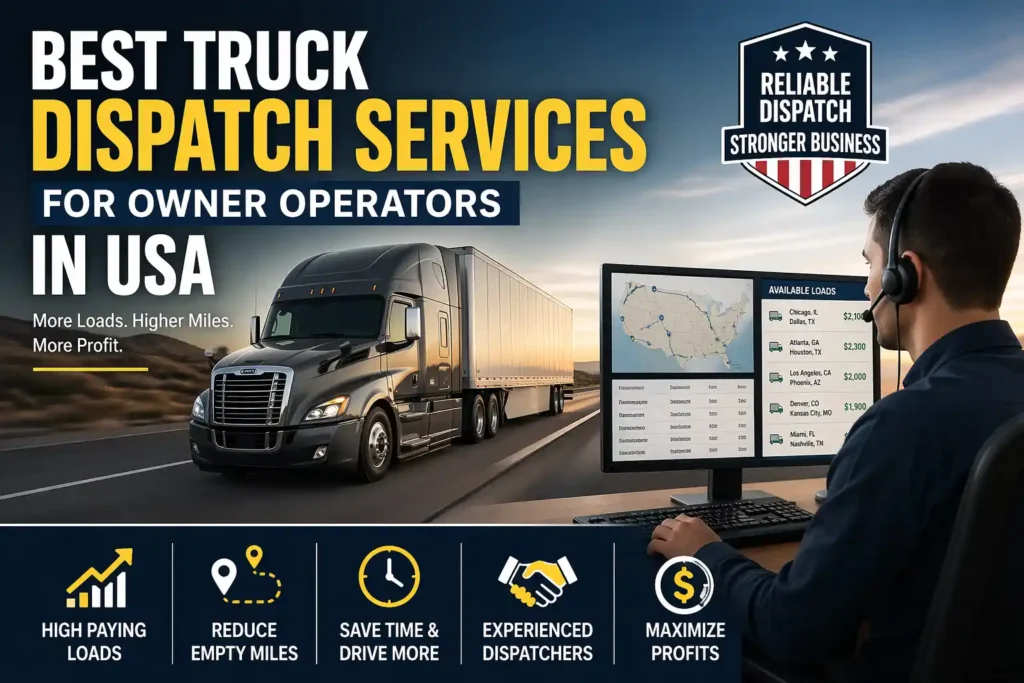
What is a truck dispatch service?
A truck dispatch service is a support service that assists truck drivers and owner operators with locating freight loads and securing them. Tasked with searching, negotiating, and making bookings, dispatchers are no longer using hours in load boards.
They have a straightforward occupation:
-
- Find available loads
-
- Contact brokers
-
- Negotiate rates
-
- Freight by truck your books.
-
- Handle basic paperwork
Simply put, they are intermediated, drivers and freight brokers.
Why owner operators need dispatch services
A lot of owner operators begin by thinking that they can do it all on their own. However, in the long run, the majority of them realize that it is a full-time job to find regular loads.
This is the actual use of dispatch services:
Saves time
You do not need to search loads all day, but instead you will be able to focus on driving and deliveries.
Better load access
Direct broker connections are often not available publicly on load boards and can only be provided by dispatchers.
Higher earning potential
An experienced dispatcher will think of how to get better freight rates.
Reduced empty miles
Fractionate dispatching makes you get backloads and limits deadhead movements.
Consistent work
Rather than random loads, you have more stable weekly routes.
What makes a good dispatch service?
Dispatch services are not all alike. Some are professional, seasoned, and others are mere novice load finders.
In a good dispatch service, we should find:
-
- Strong broker network
-
- Freight experience in various kinds.
-
- Clear communication
-
- Transparent pricing
-
- Skill in locating well-paying loads.
-
- Fixed assistance for your type of truck.
When a dispatcher cannot regularly supply loads, then what is the point?
Types of dispatch services for owner operators
This is because various trucks demand varying forms of dispatch support.
Box truck dispatching services.
Purposely used in Amazon relay and local freight, focused on local and regional delivery loads.
Flatbed dispatch services
Specializes in heavy and oversized freight like construction materials and equipment.
Hotshot dispatch services.
Pickup trucks with trailers are used to load fast delivery loads, which may be time-sensitive freight.
Reefer dispatch services
During the transportation of products under a certain temperature (food and pharmaceuticals).
Dry van dispatch service.
One of the most prevalent ones is transporting general freight interstate.
How dispatch services help increase profits
A good dispatching service is not one that simply locates loads. It has a direct effect on your income.
They help by:
-
- Finding higher-paying lanes
-
- Avoiding low-rate brokers
-
- Planning efficient routes
-
- Reducing fuel waste
-
- Booking backhaul loads
A single percent change in rate per mile can result in a huge rise in monthly earnings.
Common mistakes owner operators make
Too many drivers can not work not due to the absence of work, but due to the miscalculations:
-
- Taking low loads too readily.
-
- Collaborations with inexperienced dispatchers.
-
- Using a single source of load.
-
- Failure to plan the return trips.
-
- Not considering fuel and route efficiency.
These are some of the mistakes that should be avoided to contribute significantly to profitability.
How to choose the best truck dispatch service in USA
Check: Before working with any dispatch company, examine:
Experience
The length of time that they have been in the trucking industry.
Load network
The existence of strong relationships with brokers and shippers.
Transparency
Proper definition of fees and commission system.
Communication
Quick reaction and adequate movement updates on loads.
Results
Potential to supply regular and lucrative loads.
Conclusion
A good dispatch service is more than a support tool to owner operators in the USA: it can be a business partner. It not only curbs downtime but also improves the quality of loads and overall profits.
The thing, though, is selecting the appropriate dispatcher. One feeble service will cost you time, and a good one will always get your truck going and make you a profit.
Assuming that you want consistent traffic and improved revenues, then one of the most efficient dosses that you can take in the trucking sector is to engage a solid dispatch service.