A step-by-step planning guide for owner-operators.
Bad freight doesn’t usually lead to weak weeks in the trucking business. Most often, they start a string of pretty good choices that don’t lead to a viable action plan.
Many times, owner operators report weeks when the rates seemed good, and they moved around, but at the end of the week, it wasn’t worth it. Miles didn’t meet expectations. It was too late to wait any longer. Late charges and/or forced repositioning runs. On Friday, it was not just one load – it was the week in question.
That’s a trend that’s not anecdotal. It is a recurring occurrence in industry cost figures and utilization statistics, and is a symptom of a problem with the work planning. This pattern is typical for what its owner/operators see when charting truest cost per mile over the years.

Why Weekly Planning Matters More Than Individual Loads in Trucking
There is a simple rule among industry benchmarks: Profitability is calculated based on a weekly level, NOT load-by-load.
ATRI’s Operational Costs of Trucking (OCT) consistently demonstrates that unpaid waiting, deadhead and underutilized driving time are among the fastest-rising cost-per-mile drivers. Well, lost time waits silently and increases, and prices of fuel change, and rates follow the market.
A typical weekly goal would be 2800 miles paid. If a week only ends up at 2,350 paid miles a week, instead of the expected 2,800, the lost 450 miles typically don’t miraculously turn up when the freight dries up. They disappear between loads – on docks, being moved to and from re-loads, and in outbound markets that aren’t strong. That spread, which is priced at a median of $2.20 per mile, signifies almost $1,000 lost gross income, with no “bad load” on the books! They may not be sure if it is worth the money to have structured dispatch or if it will benefit their net income. Perhaps they are not sure if hiring a dispatch service is a good idea for their bottom line or not.
How Waiting Time and Detention Quietly Reduce Trucking Profit
This is why FMCSA data shows, as well as shipper behavior has shown, that detention over two hours is still prevalent, even in the wording of contracts that should reflect pay for detention times under two hours. Three hours of waiting time repeated, and the time becomes significant for a single man working.
Nine hours per week over a week equals approximately 450 miles. When offered, detention pay is often inadequate compensation for downstream consequences: missed reloads, night loads and lesser scheduling options. The outcome is a “reaper week” — essentially free from lines, but not necessarily profitable.
They are generally underclaimed and misunderstood, and many drivers never recoup this lost time because of detention, layovers and TONU.
Though not reflected on rate confirmations, waiting always spells the difference between a week that sticks together.
Why Reload Geography Often Matters More Than Rate Per Mile
Load boards are good for conveying rates. They don’t disclose how deep to reload the coin.
Some areas may consistently struggle with outbound freight and provide drivers with poor pick-and-pick and picker or deadhead opportunities. Considering both repositioning and waiting points, a $3.00-per-mile load going to a thin market could be a worse strategy than a $2.40-per-mile load going to a freight-dense hub.
ATRI estimates that the average level of “deadhead” for owner operators is 15-20%, and this goes up to 25% and above when the weeks aren’t planned well. That’s where revenue miles shrivel, fuel and maintenance costs continue to be incurred and fixed costs blow up. Geography won’t give in the math. This is particularly noticeable during quiet deadhead between reloads.
How Tight Appointments Disrupt Weekly Load Planning
When appointments are scheduled back-to-back, it may seem like a good use of time. They cause fragility, per se.
Planning for a mid-morning delivery followed by pickup hours that are several hours away means there’s not much room for dock delays, traffic fluctuations or small ELD disruptions. Time is of the essence – if coordination fails, there are few recovery options. Weakness comes to re-loads, and the remaining days of the week become reactive.
This can start as a simple scheduling gamble, only to become a structural loss.
Why Load Boards Don’t Show the Full Picture of Weekly Performance
Load boards work on the premise of a snapshot of supply and demand. They respond to what is present, rather than how their present decision will influence choices in the future.
Not necessarily taking care of lane continuity, appointment hurry or reloading reliability. This means that drivers who use one load at a time are usually able to get a good short-term rate, while neglecting to achieve a good weekly utilization rate. As a consequence, this gives unreliable results over time, even if the individual loads seem to seem fine individually.
This is an acknowledged feature by experienced operators, and often the headline rate is reduced slightly in order to maintain a cost of flow, reload timing and paid-mile ratio.
Why Weekly Load Planning Outperforms Load-by-Load Decisions
Some drivers are consistently outperforming industry averages, who seem to be thinking more in weeks and not loads. As experienced shippers, they tend to flock to repeat lanes and markets with repeatable reload practices. Deadhead is a positioning tool, not an emergency.
This is consistent with ATRI’s research showing time efficiency (not rate per mile) is a key factor in profitability. Little changes in utilization count a whole lot, but one-time rate spikes generally do not.
Why Even Experienced Owner-Operators Struggle With Weekly Planning
Many owner operators are dealing with all aspects of driving, sales, scheduling, compliance, paperwork and negotiation. With that load, planning frequently has to be a reactive exercise. Victory Works will not be doing pre-shipment inspection for reloads. Change of lanes mid-week. Rate discussions are under time pressure, NOT leverage.
It’s not a lack of discipline or a lack of experience. This is a capacity restriction.
How Dispatch Support Improves Weekly Planning and Load Sequencing
The dispatch support doesn’t produce any freight. It reduces waste.
When it’s done best, dispatch isn’t doing dispatch; it’s coordinating the week. This involves identifying a reload prior to delivery, driving in freight lanes instead of passenger lanes, managing the communication of the broker early, and won’t put up with brokers who want to squeeze him for less than the price he deserves – at least with timing intact. Simple deadhead or waiting time decreases cost hundreds of dollars per week without adding driving time.
Going from 25% deadhead to 18% on a 2,800-mile target week is a structural gain of almost 200 paid miles and isn’t a market fluke.
Conclusion
All data here clearly shows that there are no good weeks in a bad load and there are no bad weeks in a good load.
Paid-mile percentage, Reload positioning, Waiting time and Planning discipline determine the weekly performance. If operators are appraising loads individually, they may be missing out on some profit opportunities. The believers of planning: those who plan the whole week, individually or with support, reduce waste and stabilise outcomes.
The advantages of trucking are not obtaining the best load.
It is a building week that keeps together.
For many owner operators, the solution to improving their weekly performance is as simple as better load sequencing, broker communication and planning for relocations – and there are professional dispatch providers that can assist in reducing deadhead and unpaid time.
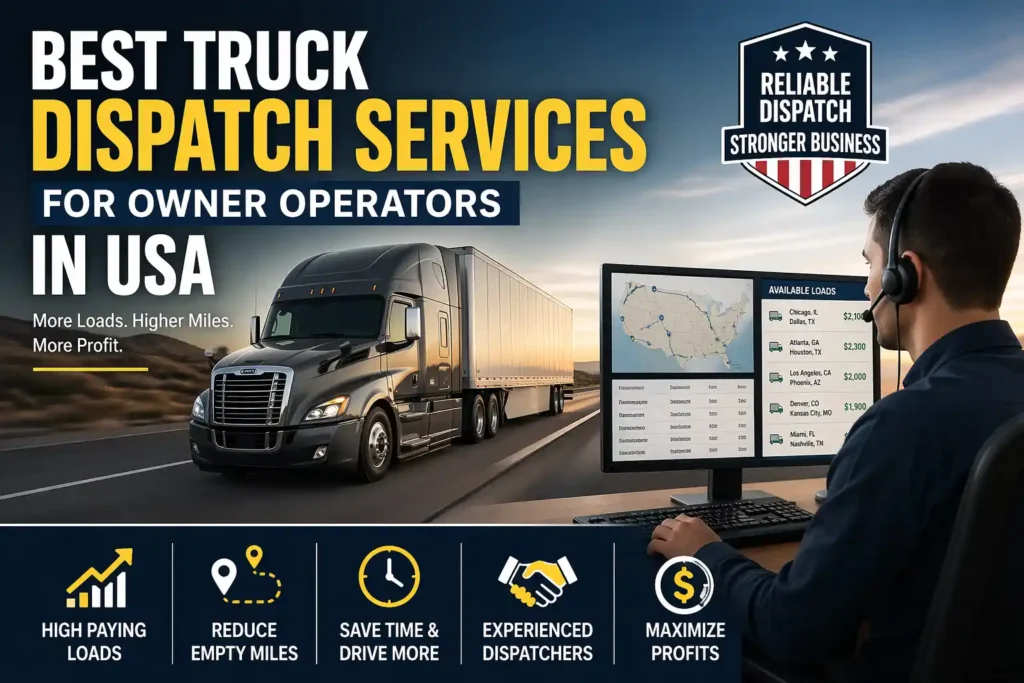
In the case of owner operators in the USA, it is more difficult to find steady and well-compensated loads than the actual driving of the truck. The competition is intense, the brokers are quick, and any good freight will hardly have a lengthy shelf life. Here is where dispatch services are involved. An experienced dispatcher could save some money, lessen dead air miles and enable you to drive more rather than drive all day trying to locate loads.
This guide defines exactly what truck dispatch services are, why they are important to owner operators and how to select the one that fits best in your trucking industry.
What is a truck dispatch service?
A truck dispatch service is a support service that assists truck drivers and owner operators with locating freight loads and securing them. Tasked with searching, negotiating, and making bookings, dispatchers are no longer using hours in load boards.
They have a straightforward occupation:
-
- Find available loads
-
- Contact brokers
-
- Negotiate rates
-
- Freight by truck your books.
-
- Handle basic paperwork
Simply put, they are intermediated, drivers and freight brokers.
Why owner operators need dispatch services
A lot of owner operators begin by thinking that they can do it all on their own. However, in the long run, the majority of them realize that it is a full-time job to find regular loads.
This is the actual use of dispatch services:
Saves time
You do not need to search loads all day, but instead you will be able to focus on driving and deliveries.
Better load access
Direct broker connections are often not available publicly on load boards and can only be provided by dispatchers.
Higher earning potential
An experienced dispatcher will think of how to get better freight rates.
Reduced empty miles
Fractionate dispatching makes you get backloads and limits deadhead movements.
Consistent work
Rather than random loads, you have more stable weekly routes.
What makes a good dispatch service?
Dispatch services are not all alike. Some are professional, seasoned, and others are mere novice load finders.
In a good dispatch service, we should find:
-
- Strong broker network
-
- Freight experience in various kinds.
-
- Clear communication
-
- Transparent pricing
-
- Skill in locating well-paying loads.
-
- Fixed assistance for your type of truck.
When a dispatcher cannot regularly supply loads, then what is the point?
Types of dispatch services for owner operators
This is because various trucks demand varying forms of dispatch support.
Box truck dispatching services.
Purposely used in Amazon relay and local freight, focused on local and regional delivery loads.
Flatbed dispatch services
Specializes in heavy and oversized freight like construction materials and equipment.
Hotshot dispatch services.
Pickup trucks with trailers are used to load fast delivery loads, which may be time-sensitive freight.
Reefer dispatch services
During the transportation of products under a certain temperature (food and pharmaceuticals).
Dry van dispatch service.
One of the most prevalent ones is transporting general freight interstate.
How dispatch services help increase profits
A good dispatching service is not one that simply locates loads. It has a direct effect on your income.
They help by:
-
- Finding higher-paying lanes
-
- Avoiding low-rate brokers
-
- Planning efficient routes
-
- Reducing fuel waste
-
- Booking backhaul loads
A single percent change in rate per mile can result in a huge rise in monthly earnings.
Common mistakes owner operators make
Too many drivers can not work not due to the absence of work, but due to the miscalculations:
-
- Taking low loads too readily.
-
- Collaborations with inexperienced dispatchers.
-
- Using a single source of load.
-
- Failure to plan the return trips.
-
- Not considering fuel and route efficiency.
These are some of the mistakes that should be avoided to contribute significantly to profitability.
How to choose the best truck dispatch service in USA
Check: Before working with any dispatch company, examine:
Experience
The length of time that they have been in the trucking industry.
Load network
The existence of strong relationships with brokers and shippers.
Transparency
Proper definition of fees and commission system.
Communication
Quick reaction and adequate movement updates on loads.
Results
Potential to supply regular and lucrative loads.
Conclusion
A good dispatch service is more than a support tool to owner operators in the USA: it can be a business partner. It not only curbs downtime but also improves the quality of loads and overall profits.
The thing, though, is selecting the appropriate dispatcher. One feeble service will cost you time, and a good one will always get your truck going and make you a profit.
Assuming that you want consistent traffic and improved revenues, then one of the most efficient dosses that you can take in the trucking sector is to engage a solid dispatch service.