Hiring a truck dispatch company can make running a trucking business easier. Owner-operators and fleet managers often need help finding loads, negotiating rates, communicating with brokers, and handling shipment paperwork. A dispatcher can take care of many of these responsibilities, giving carriers more time to focus on driving and managing their operations.
But before hiring a dispatch company, most carriers want to understand one thing: how much does it cost?
Truck dispatch companies use different pricing methods. Some charge a percentage of the load revenue, while others offer a flat fee per load or a fixed weekly or monthly payment. The right option depends on your trucking operation, the services you need, and the terms of the agreement.
Understanding these pricing structures can help you compare dispatch companies, plan your expenses, and avoid unexpected charges.
How Much Do Truck Dispatch Companies Charge Carriers?
There is no single price that every truck dispatch company follows. Dispatch fees vary based on the company’s pricing model, the services included, equipment type, and the agreement with the carrier.
Most dispatch companies use one of these pricing methods:
Percentage-based dispatch fees
Flat fees per load
Weekly or monthly fixed fees
Customized pricing for small fleets
Each option has its own advantages. Before choosing a company, understand how its pricing works and what you will receive in return.
1. Percentage-Based Dispatch Fees
Percentage-based pricing is one of the most common ways dispatch companies charge carriers. Under this arrangement, the dispatcher receives an agreed percentage of the gross revenue from the loads they book.
For example, if your dispatcher charges 5% on a $2,000 load, the dispatch fee will be $100.
Here is a simple breakdown:
Gross Load Revenue
Dispatch Fee at 5%
$1,000
$50
$1,500
$75
$2,000
$100
$2,500
$125
$3,000
$150
These figures are examples, not fixed industry rates. Actual percentages depend on the dispatch company and the services included in the agreement.
Why Do Dispatch Companies Charge a Percentage?
This pricing method connects the dispatcher’s fee to the value of the loads booked. When the gross load revenue increases, the dispatch fee also increases. When the load revenue is lower, the fee decreases.
For carriers, this can be easier to manage than paying a fixed amount every week, especially when freight volume changes.
What Should Carriers Check?
Before agreeing to a percentage-based fee, ask the dispatch company how it calculates the amount.
Find out whether the percentage applies to the gross rate on the rate confirmation, whether it applies only to loads booked by the dispatcher, and whether any additional charges are involved.
These details should be clearly explained before you start working together.
2. Flat Fee Per Load
Some truck dispatch companies charge a fixed amount for every load they book. Unlike percentage-based pricing, the fee does not change with the total load rate.
For example, a dispatcher may charge $75 per booked load. Whether the shipment pays $1,500 or $2,500, the dispatch fee remains $75.
How Does Flat-Fee Pricing Work?
The carrier and dispatcher agree on a fixed amount for each load handled by the dispatch company. This amount should be mentioned clearly in the dispatch agreement.
One advantage is that carriers can calculate the dispatch expense before accepting a load.
When Is a Flat Fee a Good Option?
A flat fee may work well for carriers who regularly book higher-value loads and prefer predictable dispatch expenses.
However, the same fee can take a larger percentage of a lower-paying load. For this reason, compare the flat charge with your expected revenue and operating costs.
3. Weekly or Monthly Dispatch Fees
Some dispatch companies offer fixed weekly or monthly pricing. Carriers pay an agreed amount for dispatch support during a specific period.
Depending on the company, this arrangement may include load searching, broker communication, rate negotiation, and paperwork assistance.
For example, a carrier may prefer a weekly payment because it makes budgeting easier and avoids calculating a separate percentage for every load.
What Should You Ask Before Choosing This Plan?
Before accepting a weekly or monthly arrangement, clarify a few important details:
How many trucks are covered by the fee?
Is there a limit on the number of loads?
Are rate negotiations included?
Does the company handle broker communication?
Are paperwork services part of the package?
Do you still pay when your truck is not operating?
A fixed payment can make expenses more predictable, but only when the services included are clearly defined.
4. Customized Pricing for Small Fleets
A carrier operating one truck may have different dispatch needs from a company managing five or ten trucks.
Small fleets often require help coordinating multiple drivers, truck locations, pickup appointments, delivery schedules, and upcoming freight.
Some dispatch companies offer customized pricing based on the number of trucks and the amount of support required.
Before accepting a fleet pricing arrangement, explain your equipment types, operating schedule, and expected workload. This helps both sides agree on a fee that reflects the actual work involved.
What Services Are Usually Included in a Dispatch Fee?
The price of a dispatch service should be considered alongside the work the company performs. Not every company provides the same level of support, so carriers should confirm what is included.
Load Searching and Booking
Dispatchers search load boards and other freight sources to find shipments that match your equipment, location, and preferred routes.
They may compare available loads, contact brokers, and present suitable options for your approval.
Rate Negotiation
A dispatcher can communicate with brokers and negotiate freight rates based on mileage, shipment requirements, and market conditions.
The purpose is to help carriers evaluate available freight and avoid accepting loads without considering their operating expenses.
Broker Communication
Dispatch companies may handle routine communication with brokers, including pickup details, delivery appointments, shipment updates, and load-related questions.
This can reduce the time carriers spend managing calls and emails.
Rate Confirmations and Paperwork
Some dispatch services help review rate confirmations, organize shipment information, and coordinate paperwork required for a load.
Carriers should still review important documents themselves and understand the terms before accepting a shipment.
Route and Load Planning
Dispatchers may help evaluate mileage, pickup and delivery locations, and available freight for the next trip.
Good planning can help carriers avoid unnecessary empty miles when suitable loads are available and make better use of their operating time.
Are There Any Additional Fees in Truck Dispatch Services?
A dispatch company’s advertised price does not always explain the full cost. Some companies may charge additional fees depending on their policies and the services requested.
Before signing an agreement, ask whether any of the following charges apply.
Setup fees: Some companies may charge an initial fee before starting dispatch services. Ask what it covers and whether it is refundable.
Cancellation fees: Check whether you need to pay anything if you decide to end the dispatch agreement.
Paperwork charges: Confirm whether document handling and administrative support are included in the main fee.
Minimum payment requirements: Some agreements may require a minimum weekly or monthly payment even when your truck books fewer loads.
Additional truck charges: If you operate multiple trucks, ask whether the quoted price covers your entire fleet or whether each truck has a separate fee.
Not every dispatch company charges these fees. The important thing is to ask for a complete pricing breakdown instead of relying only on an advertised percentage.
How to Compare Dispatch Fees Before Hiring a Company
Choosing a dispatch company based only on price can lead to problems. A cheaper service may offer limited support, while another company may charge more because it handles additional responsibilities.
Here are some points worth comparing before making a decision.
Compare the Pricing Structure
Find out whether the company charges a percentage, flat fee, or weekly payment. Calculate what each option would cost based on your average load revenue and booking frequency.
Check the Services Included
Ask whether load searching, rate negotiation, broker communication, paperwork, and route planning are included in the quoted price.
Review the Dispatch Agreement
Read the agreement carefully. Pay attention to fee calculations, payment terms, cancellation conditions, and the responsibilities of both parties.
Ask About Equipment Experience
Your freight requirements depend on the equipment you operate. A dry van carrier may need different dispatch support from a flatbed, reefer, step deck, box truck, or hotshot operator.
Choose a dispatch company that understands your equipment and the type of freight you want to haul.
Evaluate Communication
A good dispatcher should keep you informed about available loads, rate discussions, and shipment details. You should also know how to reach the company when questions or problems arise.
How Arrow Dispatch Services Supports Carriers
Understanding dispatch fees is an important part of choosing a dispatch partner, but price is not the only factor. Carriers also need a service that understands their equipment, freight requirements, and daily operating challenges.
Arrow Dispatch Services focuses on supporting owner-operators and carriers with load searching, freight booking, broker communication, rate negotiations, and shipment coordination.
Whether you operate a dry van, flatbed, reefer, box truck, or hotshot, your dispatch requirements depend on your equipment, preferred lanes, and business goals.
A clear working arrangement helps you understand what services are provided, how the fees are calculated, and which loads are being considered for your truck. Carriers should always remain involved in approving loads and reviewing shipment terms.
When comparing dispatch companies, look beyond the advertised price. Consider the quality of support, communication, pricing transparency, and whether the service fits your trucking operation.
Frequently Asked Questions
How do most truck dispatch companies charge carriers?
Many dispatch companies charge a percentage of the gross load revenue. Others use a flat fee per load or a fixed weekly or monthly payment. The pricing depends on the company and the agreement.
What is a percentage-based dispatch fee?
A percentage-based dispatch fee is calculated from the agreed load revenue. For example, if a dispatcher charges 5% on a $2,000 load, the fee is $100.
Do truck dispatch companies charge per load?
Yes. Some companies charge a fixed amount for every load they book. The fee remains the same regardless of the shipment’s total rate.
Is a flat fee better than a percentage-based fee?
It depends on your average load revenue and booking frequency. A flat fee offers predictable costs, while percentage-based pricing changes with the value of each load.
Do dispatch companies charge setup or cancellation fees?
Some companies may charge additional fees, while others do not. Review the dispatch agreement and ask for a complete list of charges before signing.
Are rate negotiation and paperwork included in dispatch fees?
Some companies include these services in their main fee, while others offer different service packages. Always confirm what is covered before hiring a dispatcher.
Can small fleets get customized dispatch pricing?
Yes. Some dispatch companies offer customized arrangements based on fleet size, equipment, and the amount of dispatch support required.
Final Thoughts
Truck dispatch companies use different pricing methods, and understanding them can help carriers manage their business expenses. Percentage-based fees, flat charges, and weekly or monthly plans each have different advantages depending on your trucking operation.
Before hiring a dispatcher, calculate the expected cost, review the services included, and read the agreement carefully. Do not choose a company based only on the lowest advertised fee.
The right dispatch arrangement should provide useful support, transparent pricing, and reliable communication. When the service fits your budget and helps you manage freight more efficiently, it can be a practical investment for your trucking business.
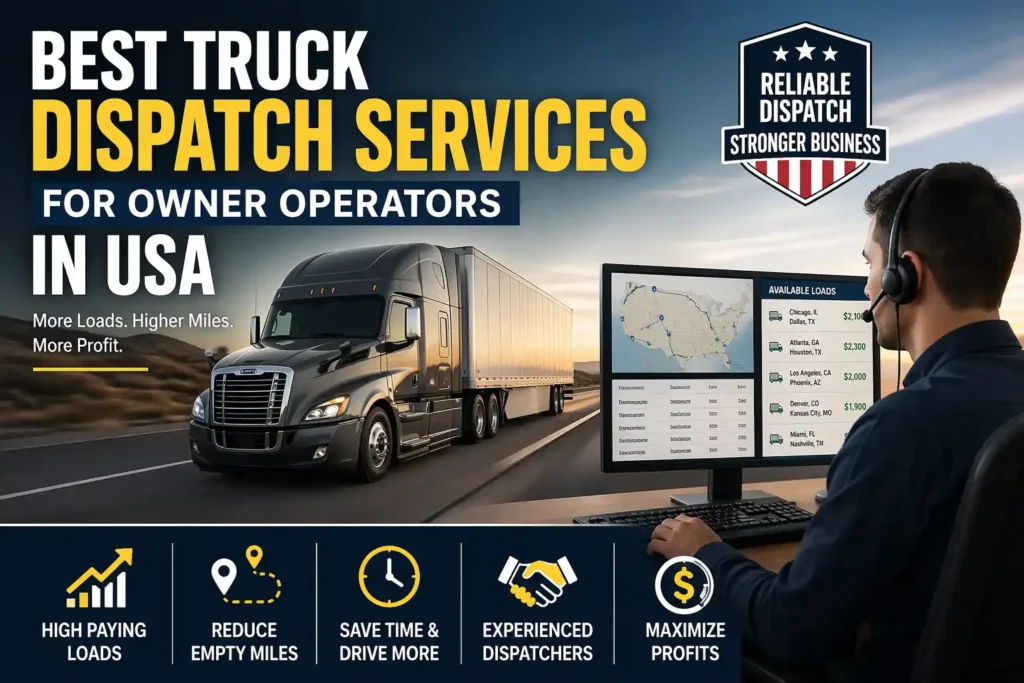
In the case of owner operators in the USA, it is more difficult to find steady and well-compensated loads than the actual driving of the truck. The competition is intense, the brokers are quick, and any good freight will hardly have a lengthy shelf life. Here is where dispatch services are involved. An experienced dispatcher could save some money, lessen dead air miles and enable you to drive more rather than drive all day trying to locate loads.
This guide defines exactly what truck dispatch services are, why they are important to owner operators and how to select the one that fits best in your trucking industry.
What is a truck dispatch service?
A truck dispatch service is a support service that assists truck drivers and owner operators with locating freight loads and securing them. Tasked with searching, negotiating, and making bookings, dispatchers are no longer using hours in load boards.
They have a straightforward occupation:
Find available loads
Contact brokers
Negotiate rates
Freight by truck your books.
Handle basic paperwork
Simply put, they are intermediated, drivers and freight brokers.
Why owner operators need dispatch services
A lot of owner operators begin by thinking that they can do it all on their own. However, in the long run, the majority of them realize that it is a full-time job to find regular loads.
This is the actual use of dispatch services:
Saves time
You do not need to search loads all day, but instead you will be able to focus on driving and deliveries.
Better load access
Direct broker connections are often not available publicly on load boards and can only be provided by dispatchers.
Higher earning potential
An experienced dispatcher will think of how to get better freight rates.
Reduced empty miles
Fractionate dispatching makes you get backloads and limits deadhead movements.
Consistent work
Rather than random loads, you have more stable weekly routes.
What makes a good dispatch service?
Dispatch services are not all alike. Some are professional, seasoned, and others are mere novice load finders.
In a good dispatch service, we should find:
Strong broker network
Freight experience in various kinds.
Clear communication
Transparent pricing
Skill in locating well-paying loads.
Fixed assistance for your type of truck.
When a dispatcher cannot regularly supply loads, then what is the point?
Types of dispatch services for owner operators
This is because various trucks demand varying forms of dispatch support.
Box truck dispatching services.
Purposely used in Amazon relay and local freight, focused on local and regional delivery loads.
Flatbed dispatch services
Specializes in heavy and oversized freight like construction materials and equipment.
Hotshot dispatch services.
Pickup trucks with trailers are used to load fast delivery loads, which may be time-sensitive freight.
Reefer dispatch services
During the transportation of products under a certain temperature (food and pharmaceuticals).
Dry van dispatch service.
One of the most prevalent ones is transporting general freight interstate.
How dispatch services help increase profits
A good dispatching service is not one that simply locates loads. It has a direct effect on your income.
They help by:
Finding higher-paying lanes
Avoiding low-rate brokers
Planning efficient routes
Reducing fuel waste
Booking backhaul loads
A single percent change in rate per mile can result in a huge rise in monthly earnings.
Common mistakes owner operators make
Too many drivers can not work not due to the absence of work, but due to the miscalculations:
Taking low loads too readily.
Collaborations with inexperienced dispatchers.
Using a single source of load.
Failure to plan the return trips.
Not considering fuel and route efficiency.
These are some of the mistakes that should be avoided to contribute significantly to profitability.
How to choose the best truck dispatch service in USA
Check: Before working with any dispatch company, examine:
Experience
The length of time that they have been in the trucking industry.
Load network
The existence of strong relationships with brokers and shippers.
Transparency
Proper definition of fees and commission system.
Communication
Quick reaction and adequate movement updates on loads.
Results
Potential to supply regular and lucrative loads.
Conclusion
A good dispatch service is more than a support tool to owner operators in the USA: it can be a business partner. It not only curbs downtime but also improves the quality of loads and overall profits.
The thing, though, is selecting the appropriate dispatcher. One feeble service will cost you time, and a good one will always get your truck going and make you a profit.
Assuming that you want consistent traffic and improved revenues, then one of the most efficient dosses that you can take in the trucking sector is to engage a solid dispatch service.