Starting a business isn’t a job decision. This is a transition between driver pay and business risk management.
Truck owner = revenue, expenses, lane decision, compliance risk, and authority presence. The plus side is you’re free to choose your own work and earn the higher gross potential. The drawback is the responsibility of operations – insurance, fluctuations in fuel costs, potential breakdown, compliance audits, as well as decisions about load planning are all in your hands.
If your vision isn’t simply “buying a truck,” then this guide will detail what it takes to build a stable operation.
The Initial Measures: Acquiring an Understanding of Your New Profession
There are a few things that you need to take into consideration before you decide to get started building your company and become an owner-operator truck driver.
Do you want to live your work life like this? With a passion for driving and logistics, the answer to this question will likely be a yes. Additionally, it’s best to understand the advantages and disadvantages of an owner-operator truck driver. If you are an owner-operator truck driver, you may not realize the pay off of your initial money quickly. Remember this, and make sure you mentally prepare yourself for what may follow: the stress and apprehension of being a self-employed person.
So, what are the first steps that need to be taken to start owning an owner-operator truck driver? Do you have all the required prerequisites? The first step to obtaining a commercial driver’s license (CDL) is to obtain a regular driver’s license in good standing without any pending legal judgments.
Do you see any future expenses coming? You will have many different types of expenses running the new business, and these expenses will include vehicle maintenance costs, et cetera, as well as insurance and any taxes. You must be prepared to cover these expenses, and it’s vital to know how they could impact the profitability of your business. Do you feel you are prepared to establish yourself in a different career? The payoff and return on investment (ROI) in your endeavour to make your owner-operator trucking business work will pay off many-fold. It does require dedication, so make sure that you’re willing to devote your time to realizing this goal.
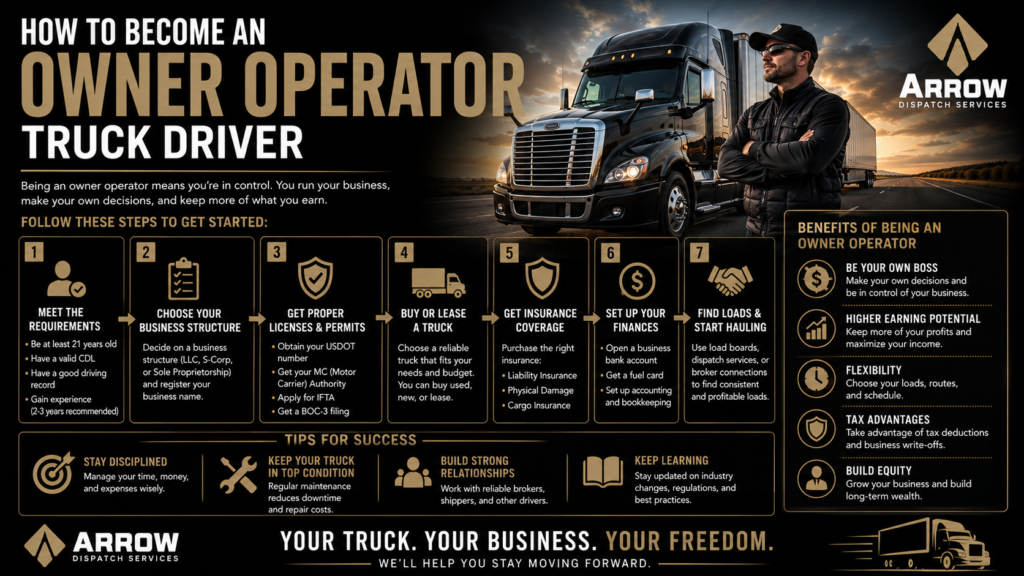
How to Get Started: The Steps You Need to Take to Become an Owner-Operator Truck Driver
Obtain Your Qualifications
If you’re interested in becoming an owner-operator truck driver, then you must obtain your commercial driver’s license. This is the first step in the process. Your ordinary driver’s license will need to be supplemented with this supplementary license in order for you to be able to operate heavy goods trucks or vehicles transporting cargo that has been registered as hazardous. Your first major step towards having your own logistics company is getting the Commercial Driver’s License (CDL).
As part of the CDL application process, the Department of Transport will perform a physical test to assess applicants’ physical fitness. You’ll also have to decide what type of license you need for your business vehicle because each type of license available to the driver indicates how the driver is allowed to operate commercial vehicles.
Gain an understanding of the Expenses Faced by Owner-Operator Truck Drivers.
A successful company can only be built when it sets up a solid strategy for the future of the company. Review your finances and make sure that you know all of the expenses you’ll have in your first year of business. Take into account the costs of owning your own truck and becoming an owner-operator. These costs include things like the necessary equipment, as well as insurance and other everyday costs.
It is not something that you would be able to build up a successful trucking business within the span of a year, and most likely, you will feel the returns of your investment only after you have been in the new profession of being a truck driver for at least one year. This is because, in order to start a new career, one has to go through a learning curve. In some cases, this could be a lot longer. Having an understanding of your financial situation and working up a strategy for managing it can assist in shielding you from the possibility of declaring bankruptcy.
One area most new owner operators underestimate is Cash flow Timing. Fuel is paid today. Repair is paid on the day of the repairs. Insurance is a payment made on a monthly basis. However, with the broker, you can expect to wait for payment for 30 days or longer. Just as importantly, like getting rates, is understanding payment cycles.
Remember, Tax Deductions are available to Owner-Operator Truck Drivers.
It is important to note that, as you evaluate the elements of a plan for your company, you will also consider a number of costs alongside the tax savings you are eligible for as an owner/operator truck driver. Taxable income could be lowered by deducting expenses, including the cost of equipment and maintenance, from your total income.
Knowing this is crucial as the funds that you can save on your tax bill will make it extremely simple for you to plan the future of your business effectively.
Build Your Setup
You will need a lot of equipment in order to have your own trucking business. Of course, the most likely to lead to the bulk of the costs in this scenario is the truck itself, and you should take the time to give careful consideration to the type of truck that is going to best serve the needs of your new company. Before making any decision, think about what sort of items you can be shipping and what types of routes you can be taking.
As you design your collection of equipment, remember your company system and budget. If you’re finding that you’re quite different from what you first thought about your business or came up with, then you’re back to where you originally had to start, so you should make a new business plan for your business.
Register Your Business
The Commercial Driver’s License (CDL) is what you can use as the basis for your license and registration as a commercial truck driver. You may need to obtain other licenses in advance, depending on the state you conduct business in, before obtaining the right to take freight out on the roads. An appropriate authority, such as your state’s Department of Transport, can provide you with guidance as to what licenses you should obtain.
It takes only seconds before your safety performance counts once you’re registered. Audit exposure in the FMCSA safety audit process can be raised due to violations, preventable accidents, and inspection failures.
Along with that, you’ll need to register your firm as well. It’s likely that your owner-operator company may be in several states; however, you will want to register in the state where your main office is located. Running your company from home is a choice you can make to avoid overheads, but you’ll still need to register your business here.
Make a Decision On Your Career Path
As an owner-operator, you can operate it or lease it to another company. There are a number of benefits and disadvantages to each alternative, depending on the point of view.
So, if you’re looking to operate independently, you’ll just have to find customers and establish your operation. In addition, the management of your company will provide you with more leeway and independence.
When you lease to a company, you’ll find it easier to find the loads and contracts that you need to grow your business, but the terms and conditions of the company you lease from will dictate how you’re doing business. Following a serious consideration of both choices, you should decide on which type of commercial enterprise to choose, based on both short and long-term objectives.
Obtain Insurance
The kind of insurance you will require is also dependent on the type you previously decided to get. You may work with an organization that might be capable of offering you a portion of the insurance policy needed if you do so. For a self-employed individual to conduct business on their own terms, they will be responsible for securing and funding their own insurance.
The types of insurance required will differ based on the different states and jurisdictions. It is essential that your insurance protects you in all of the various regions in which you want to do business. This will make sure that you have 100 percent compliance with the current laws, and you will have 100 per cent peace of mind.
Find out how to reach out to prospective employers:
As the owner and operator of a trucking company, one of the most crucial jobs you have to deal with is finding jobs and loads to carry. When seeking cargo from a freight broker, you may find that some online load boards will help you. This is an efficient method for discovering the employees you need in order to develop your company.
Many new owner-operators have a crippling dependence on spot freight in the early days. However, once you know what weekly structure looks like, when to reload, and how many hours you are allowed to run legally, then stability comes. Knowing a truck driver’s driving time, especially under HOS, has a direct impact on his weekly gross.
As you’ll work to build stronger relationships with your clients and consumers, it will be easier for you to find the leads you need to make it all pay off. It is also possible that you may discover you need to expand your activities in order to meet the demand.
The Real Shift: From Driver to Operator
There is money for driving skills. Hedgehog skills keep you in the game.
Now, as an owner-operator, you have the responsibility for:
- Lane sequencing
- Deadhead control
- Fuel cost management
- Insurance risk profile
- Compliance documentation
- Rate negotiation
- Equipment maintenance cycles
A lot of drivers are considering the top line. The successful owner operators look for net stability. Year 3 isn’t just about horsepower; it’s about structure, it’s about surviving year 1.
Build Stability From Day One
Pursuing your owner-operator career is more than just about finding loads. It’s about margin defence, lane setting, and compliance minimisation.
New and existing owner/operators can rely on the arrow dispatch services for:
- Strategic load planning
- Rate negotiation
- Compliance support
- Document management
- Authority protection
- Weekly structure optimization
If you’re not just casting out on the water for freight, consider getting in touch with the services provided for dispatching that are offered by Arrowd, and get started on a solid footing.
In the case of owner operators in the USA, it is more difficult to find steady and well-compensated loads than the actual driving of the truck. The competition is intense, the brokers are quick, and any good freight will hardly have a lengthy shelf life. Here is where dispatch services are involved. An experienced dispatcher could save some money, lessen dead air miles and enable you to drive more rather than drive all day trying to locate loads.
This guide defines exactly what truck dispatch services are, why they are important to owner operators and how to select the one that fits best in your trucking industry.
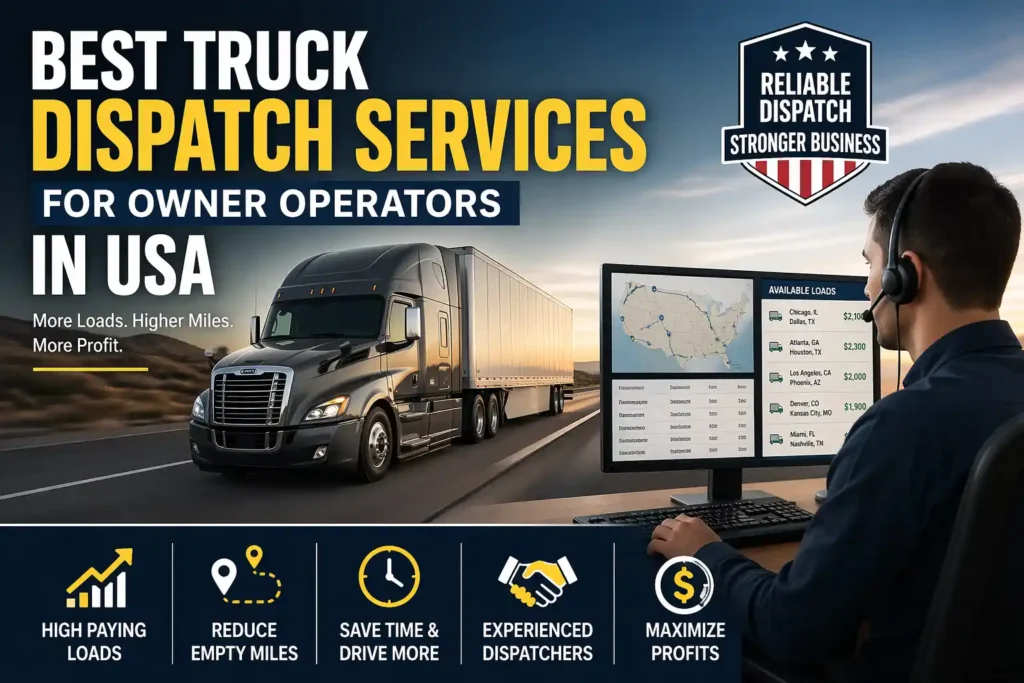
What is a truck dispatch service?
A truck dispatch service is a support service that assists truck drivers and owner operators with locating freight loads and securing them. Tasked with searching, negotiating, and making bookings, dispatchers are no longer using hours in load boards.
They have a straightforward occupation:
-
- Find available loads
-
- Contact brokers
-
- Negotiate rates
-
- Freight by truck your books.
-
- Handle basic paperwork
Simply put, they are intermediated, drivers and freight brokers.
Why owner operators need dispatch services
A lot of owner operators begin by thinking that they can do it all on their own. However, in the long run, the majority of them realize that it is a full-time job to find regular loads.
This is the actual use of dispatch services:
Saves time
You do not need to search loads all day, but instead you will be able to focus on driving and deliveries.
Better load access
Direct broker connections are often not available publicly on load boards and can only be provided by dispatchers.
Higher earning potential
An experienced dispatcher will think of how to get better freight rates.
Reduced empty miles
Fractionate dispatching makes you get backloads and limits deadhead movements.
Consistent work
Rather than random loads, you have more stable weekly routes.
What makes a good dispatch service?
Dispatch services are not all alike. Some are professional, seasoned, and others are mere novice load finders.
In a good dispatch service, we should find:
-
- Strong broker network
-
- Freight experience in various kinds.
-
- Clear communication
-
- Transparent pricing
-
- Skill in locating well-paying loads.
-
- Fixed assistance for your type of truck.
When a dispatcher cannot regularly supply loads, then what is the point?
Types of dispatch services for owner operators
This is because various trucks demand varying forms of dispatch support.
Box truck dispatching services.
Purposely used in Amazon relay and local freight, focused on local and regional delivery loads.
Flatbed dispatch services
Specializes in heavy and oversized freight like construction materials and equipment.
Hotshot dispatch services.
Pickup trucks with trailers are used to load fast delivery loads, which may be time-sensitive freight.
Reefer dispatch services
During the transportation of products under a certain temperature (food and pharmaceuticals).
Dry van dispatch service.
One of the most prevalent ones is transporting general freight interstate.
How dispatch services help increase profits
A good dispatching service is not one that simply locates loads. It has a direct effect on your income.
They help by:
-
- Finding higher-paying lanes
-
- Avoiding low-rate brokers
-
- Planning efficient routes
-
- Reducing fuel waste
-
- Booking backhaul loads
A single percent change in rate per mile can result in a huge rise in monthly earnings.
Common mistakes owner operators make
Too many drivers can not work not due to the absence of work, but due to the miscalculations:
-
- Taking low loads too readily.
-
- Collaborations with inexperienced dispatchers.
-
- Using a single source of load.
-
- Failure to plan the return trips.
-
- Not considering fuel and route efficiency.
These are some of the mistakes that should be avoided to contribute significantly to profitability.
How to choose the best truck dispatch service in USA
Check: Before working with any dispatch company, examine:
Experience
The length of time that they have been in the trucking industry.
Load network
The existence of strong relationships with brokers and shippers.
Transparency
Proper definition of fees and commission system.
Communication
Quick reaction and adequate movement updates on loads.
Results
Potential to supply regular and lucrative loads.
Conclusion
A good dispatch service is more than a support tool to owner operators in the USA: it can be a business partner. It not only curbs downtime but also improves the quality of loads and overall profits.
The thing, though, is selecting the appropriate dispatcher. One feeble service will cost you time, and a good one will always get your truck going and make you a profit.
Assuming that you want consistent traffic and improved revenues, then one of the most efficient dosses that you can take in the trucking sector is to engage a solid dispatch service.