It initially seems easy to start a trucking business. You acquire a truck, load it and start earning. However, when you really deconstruct it, you are up before the truck is even on the road with a number of costs. There are those that are open and others that are covered by the time you are already in it.
Planning to join this industry, it is worth knowing the actual cost of the startup. Not only to plan in terms of finances, but to prevent any surprises which may delay or even shut down your business during the initial period.
In this guide, all the big spending is clarified in an easy manner to enable you to get the complete picture of the situation before making any decision.
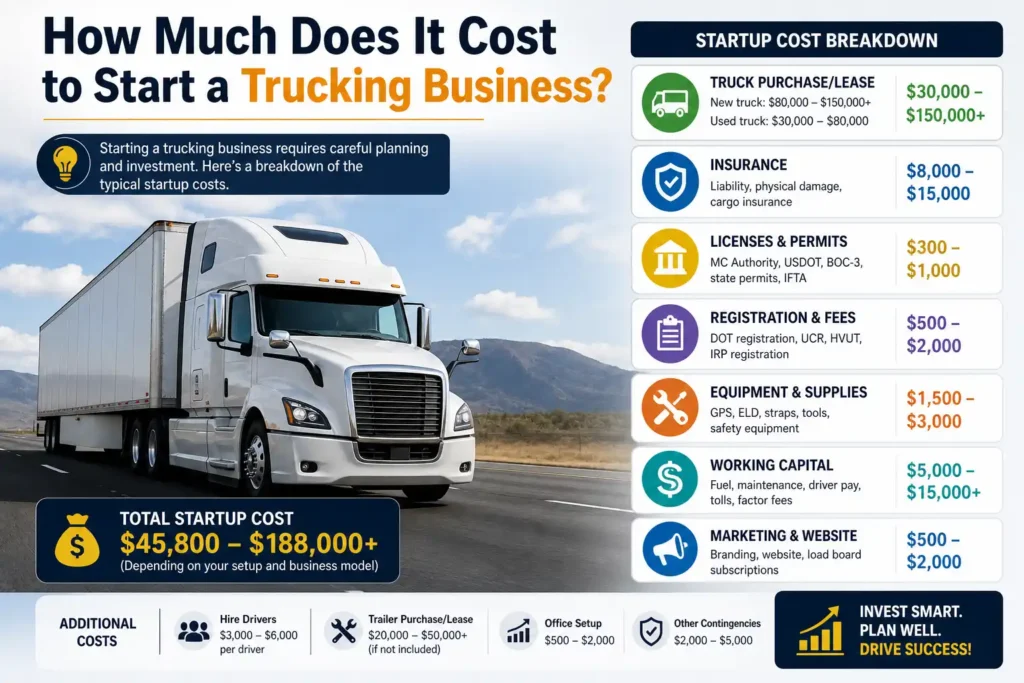
The Truck: Your Biggest Investment
The greatest cost is the truck itself. The majority of your startup budget will be here.
A used truck will be much less expensive than a brand-new truck. New trucks are normally characterized by increased fuel efficiency, warranty, and fewer repair problems during the initial years. The cost can strain your money flow, though.
Conversely, second-hand trucks are less expensive initially. This path is embraced by many new owner operators who feel free to venture into the business due to the option not being overly indebted. But, there is the risk of a maintenance issue with used trucks, in particular when the former owner did not maintain the trucks in optimal condition.
The new vs. the used will directly impact your initial price to pay and your monthly strain.
Insurance Costs You Cannot Avoid
One of the major constant costs in trucking is insurance. It is a significant part of your startup budget and is underestimated by many new drivers.
The insurance on commercial trucks is based on a number of factors:
- Driving experience
- Truck type
- Operating area
- Cargo type
- Safety record (as may be).
In case you are a novice with no trucking history, then insurance rates tend to be higher. The reason is that in the beginning, insurers consider you as a greater risk.
There are several kinds of coverage that you usually need, such as liability and cargo insurance. These can all contribute a substantial amount every month to your business.
Permits, Licensing, and Legal Setup
To act, you must be duly documented. This incorporates state and federal requirements depending on your operating level.
Some of the requirements are:
- Motor Carrier Authority
- DOT registration
- Unified Carrier Registration
- International Fuel Tax Agreement (as applicable)
- BOC-3 filing
A fee is charged on each of these. They might not appear huge individually, but when combined, they make a significant portion of your startup budget.
These steps cannot be skipped or even postponed since, in this way, you cannot legally transport freight.
Fuel Costs at the Start
Fuel is not actually a startup cost; it is, however, a startup cost the instant your truck begins to move.
Fuel is one of the highest recurrent costs in the trucking industry. Your total cost is dependent on:
- Distance traveled
- Load weight
- In various areas, fuel prices are higher.
- Truck efficiency
How fast fuel prices build up is surprising, especially to many new drivers in the first few weeks, as they still get familiar with routes and load planning.
That is why the efficiency of routes and load planning is important in the very first days. Even minor advances in planning can contribute to a tangible improvement in the long term.
Maintenance and Repairs
All trucks require simple maintenance even prior to the emergence of serious problems. The business includes oil changes, tire inspections, brake inspections and other periodical services.
In the case of used trucks, the maintenance expenses may be more difficult to predict and can be expensive. In the case of new trucks, expenses are typically cheaper in the initial stages, but they are required to maintain a warranty.
Emergency repair is one of the things that many beginners do not take into consideration. Not only the repair money, but lost income owing to missed loads can be incurred during a breakdown. The downtime can frequently be more costly than the repair.
It is wise to establish a buffer of maintenance in advance.
Dispatch Service or Load Management Costs
Provided you do not plan to search load on your own, you can use a dispatch service.
The services of dispatch assist you in locating freight, rate negotiations and maintaining communication with brokers. They, in turn, charge a percentage per load or a fee.
In the case of the new trucking industry, such an expense can, in fact, assist in enhancing incomes in the event the dispatcher is skilled. Proper dispatch seems to decrease empty miles and can be more useful to get more profitable loads.
Be careful, though. You can make less money by having a bad dispatch service instead of making more money.
Operating Expenses You Might Not Expect
There are several smaller costs that many new truck owners don’t think about at first.
These include:
- Tolls on highways
- Weigh station fees
- Parking charges
- Truck washes and cleaning
- Communication tools (phone, internet, GPS apps)
Individually, these costs seem small. But over time, they add up and become a regular part of your operating budget.
Ignoring them in planning often leads to unrealistic profit expectations.
Cost of Downtime
Downtime is one of the least considered costs in trucking.
Unless your truck is on the move, you are not earning. However, your fixed costs such as insurance, loan payments and permits remain.
Downtime may occur as a result of:
- Mechanical breakdowns
- Waiting for loads
- Poor route planning
- Seasonal slow periods
Nothing is as valuable as ensuring that you have your truck loaded at all times. Every idle day makes a difference in your monthly earnings more than you may care to acknowledge.
Realistic Startup Budget Range
No specific number will cover all trucking businesses, but we can consider a reasonable range.
The owner-operator with a small scale, who starts with a used truck, can end up spending much less than one who is purchasing a new truck with a full outfit.
You will have a startup cost that usually consists of:
- Truck purchase
- Insurance setup
- Licensing and permits
- Initial fuel
- Basic maintenance
- Operational buffer
Cole all this together, and the amount that will arise will be very variable based on your decisions and the structure of your business.
It is not only a matter of its overall amount, but also how well you are able to plan out your cash flow in the initial few months.
Why Planning Matters More Than the Budget Itself
It is believed by many that one can become successful in trucking just by the amount of money one has to begin with. As a matter of fact, planning is equal to capital.
Both drivers may have equal budgets, though the driver who is smarter with the loads, in terms of expenses and of avoiding downtime, will always work better.
It is here that things like dispatch support can help, particularly in the case of new entrants in the market that are yet to learn the business.
In the case of owner operators in the USA, it is more difficult to find steady and well-compensated loads than the actual driving of the truck. The competition is intense, the brokers are quick, and any good freight will hardly have a lengthy shelf life. Here is where dispatch services are involved. An experienced dispatcher could save some money, lessen dead air miles and enable you to drive more rather than drive all day trying to locate loads.
This guide defines exactly what truck dispatch services are, why they are important to owner operators and how to select the one that fits best in your trucking industry.
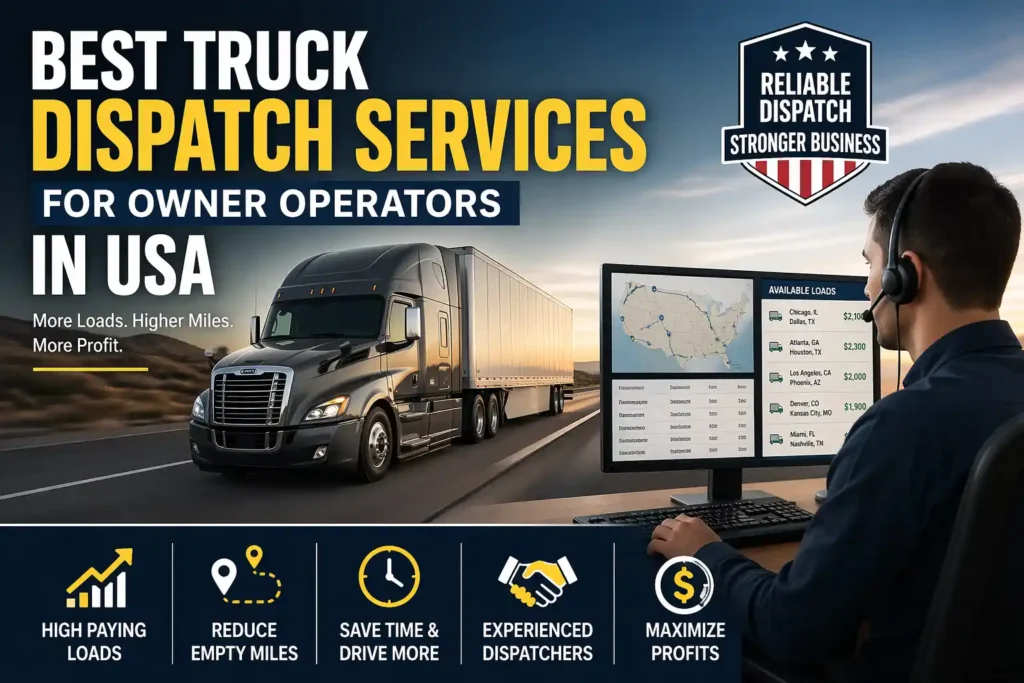
What is a truck dispatch service?
A truck dispatch service is a support service that assists truck drivers and owner operators with locating freight loads and securing them. Tasked with searching, negotiating, and making bookings, dispatchers are no longer using hours in load boards.
They have a straightforward occupation:
-
- Find available loads
-
- Contact brokers
-
- Negotiate rates
-
- Freight by truck your books.
-
- Handle basic paperwork
Simply put, they are intermediated, drivers and freight brokers.
Why owner operators need dispatch services
A lot of owner operators begin by thinking that they can do it all on their own. However, in the long run, the majority of them realize that it is a full-time job to find regular loads.
This is the actual use of dispatch services:
Saves time
You do not need to search loads all day, but instead you will be able to focus on driving and deliveries.
Better load access
Direct broker connections are often not available publicly on load boards and can only be provided by dispatchers.
Higher earning potential
An experienced dispatcher will think of how to get better freight rates.
Reduced empty miles
Fractionate dispatching makes you get backloads and limits deadhead movements.
Consistent work
Rather than random loads, you have more stable weekly routes.
What makes a good dispatch service?
Dispatch services are not all alike. Some are professional, seasoned, and others are mere novice load finders.
In a good dispatch service, we should find:
-
- Strong broker network
-
- Freight experience in various kinds.
-
- Clear communication
-
- Transparent pricing
-
- Skill in locating well-paying loads.
-
- Fixed assistance for your type of truck.
When a dispatcher cannot regularly supply loads, then what is the point?
Types of dispatch services for owner operators
This is because various trucks demand varying forms of dispatch support.
Box truck dispatching services.
Purposely used in Amazon relay and local freight, focused on local and regional delivery loads.
Flatbed dispatch services
Specializes in heavy and oversized freight like construction materials and equipment.
Hotshot dispatch services.
Pickup trucks with trailers are used to load fast delivery loads, which may be time-sensitive freight.
Reefer dispatch services
During the transportation of products under a certain temperature (food and pharmaceuticals).
Dry van dispatch service.
One of the most prevalent ones is transporting general freight interstate.
How dispatch services help increase profits
A good dispatching service is not one that simply locates loads. It has a direct effect on your income.
They help by:
-
- Finding higher-paying lanes
-
- Avoiding low-rate brokers
-
- Planning efficient routes
-
- Reducing fuel waste
-
- Booking backhaul loads
A single percent change in rate per mile can result in a huge rise in monthly earnings.
Common mistakes owner operators make
Too many drivers can not work not due to the absence of work, but due to the miscalculations:
-
- Taking low loads too readily.
-
- Collaborations with inexperienced dispatchers.
-
- Using a single source of load.
-
- Failure to plan the return trips.
-
- Not considering fuel and route efficiency.
These are some of the mistakes that should be avoided to contribute significantly to profitability.
How to choose the best truck dispatch service in USA
Check: Before working with any dispatch company, examine:
Experience
The length of time that they have been in the trucking industry.
Load network
The existence of strong relationships with brokers and shippers.
Transparency
Proper definition of fees and commission system.
Communication
Quick reaction and adequate movement updates on loads.
Results
Potential to supply regular and lucrative loads.
Conclusion
A good dispatch service is more than a support tool to owner operators in the USA: it can be a business partner. It not only curbs downtime but also improves the quality of loads and overall profits.
The thing, though, is selecting the appropriate dispatcher. One feeble service will cost you time, and a good one will always get your truck going and make you a profit.
Assuming that you want consistent traffic and improved revenues, then one of the most efficient dosses that you can take in the trucking sector is to engage a solid dispatch service.