One of the most talked about subjects among owner operators is the discussion of freight rates; A lot of drivers think that the most effective way to boost trucking income is to adopt aggressive tactics when it comes to dealing with freight rates.
On the surface, this makes lots of sense. Obviously, if you are earning more per mile, then you should be receiving more money on your paycheck each week.
Discussions with owner-operators, experienced dispatchers and fleet managers, however, know something is missing from the negotiation-only dispersion: For owners, the most successful operations invariably involve a combination of negotiations and otherwise.
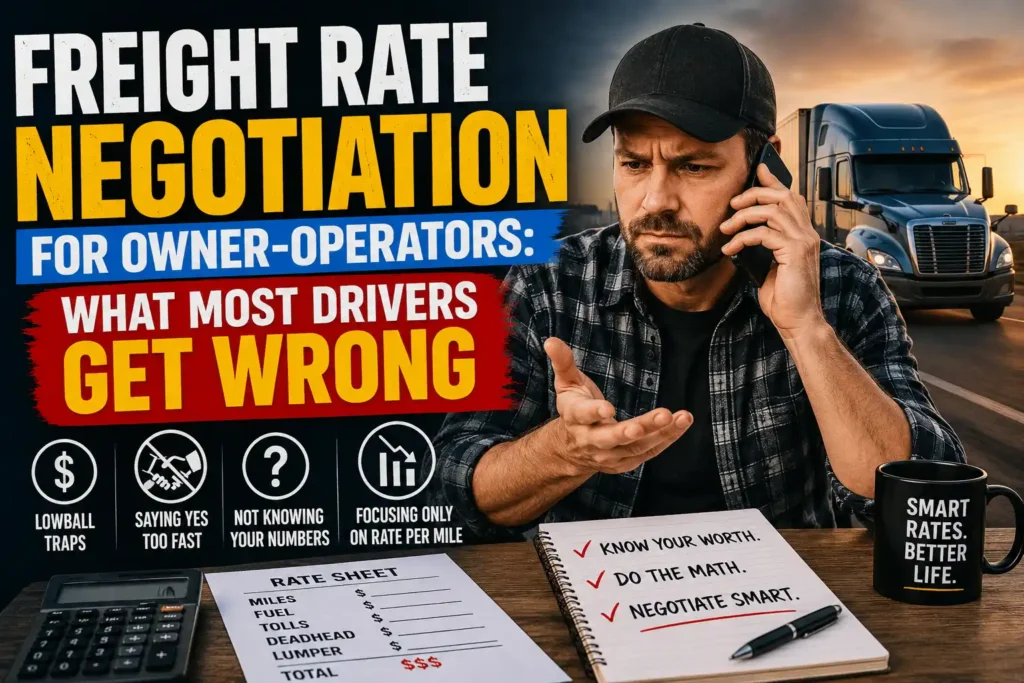
In reality, numerous operators with a strong attention on negotiating top dollar for their freight rates find that no income stabilization is brought along. In the meantime, the use of trucks that operate within dedicated lanes with predictable loading and unloading times often exceeds them, despite seemingly low loading speeds.
Freight Rate Negotiation is important. However, it is not usually the most important thing that leads to regular profitability for owner-operators.
Having a steady income is very difficult to achieve through negotiating individual loads; many experienced operators finally realize this. Rather, it is more profitable to create a framework for the whole week based on positioning and timing. That is why it can be wise to plan each week, rather than relying on a “good load” mentality when establishing a stable, trucking operation.
To shed light on the why, it’s important to understand the how, including how an entire week of trucking revenue is achieved.
Why Freight Rate Negotiation Feels Like the Biggest Lever for Owner-Operators
In trucking culture, a lot is made of freight rate negotiation, for one easy-to-understand reason: it’s the most obvious thing one can manipulate in the business.
Each load board clearly indicates rate information. One of the many things drivers do is check on load rates. Many trucking forums are filled with posts of “high-paying loads” posted on screenshots. Carriers call the broker and try to negotiate an additional $100 on the haul.
Being able to see the rate makes it the psychological benchmark for profitability.
Freight rate negotiation between owner operators and freight brokers takes place fast – generally on the phone or load board messaging systems in most instances. A broker quotes them a rate, and the carrier calls back to ask if there is any flexibility. Typically, drivers respond (counter) with relation to gas costs, lane demand or load opportunities. But in reality, seasoned operators are aware of the fact that, in most cases, it is not the negotiation as such that decides; it is how one conducts themselves in the negotiation that matters. Brokers are already very familiar with the market and typically only modify the rate in some way. Positioning is far more important than any of the above – probably the driver’s position in a strong freight market with a number of options vs the driver’s position in the area where they have little leverage.
The majority of financial stress among owner operators is due to the periods between loads, and those periods are explained in Why Owner-Operators Lose Money Between Loads.
But there’s a danger of rate negotiation giving a false focus on what trucking income is doing on an entire operating week.
$3.20 per mile may seem like a great load to load up on. However, in a poor load market, empty time becomes a problem, and if the load doesn’t mean there is another load waiting on the truck the next day, the bottom line can get bleak very quickly.
What’s important isn’t the “rate per load. This is the overall performance for the week.
The Hidden Cost Drivers That Matter More Than Freight Rate Negotiation
An elaborate trucking firm will not begin studying profitability by taking a look at the rate they have negotiated. Rather, they look at the operational factors that help make the truck fit into its operations throughout the week.
One of the most crucial elements is the timing of the reloading.
Delivery in a strong freight corridor will hasten a truck owner’s ability to line up their next load and obtain it within hours. In a less favorable freight market, a truck can wait all day for a viable load to show up. Missed return to purchase (ROTP) charges can lead to a significant drop in weekly gross sales.
Even if the rates available to a driver are good, they may be losing more than 30 percent a week if they usually get three loads a week but waive a day for waiting around for freight and only get two loads scheduled for that week.
Empty mileage is another important factor to consider.
ATRI’s research has determined that independent carriers’ empty miles typically make up 15-20 percent of overall miles driven. But operations that are not well-designed easily go well beyond that.
Empty miles are an effective liability for any week in the freight rate calculation.
Here are some factors that always affect owner-operator profits:
| Operational Factor | Impact on Owner-Operator Revenue |
| Reload timing | Determines how many loads fit into a week |
| Empty miles | Reduces the effective freight rate per mile |
| Lane familiarity | Improves broker trust and repeat freight |
| Truck positioning | Increases reload probability |
| Weekly planning | Stabilizes owner-operator income |
Why High Freight Rates Still Don’t Guarantee High Trucking Income
However, in the face of high freight rates, this may give an impression of profitability, but may also point towards other inefficiencies.
Let’s examine two imaginary situations of owners who also work in their own business.
Operator A aggressively negotiates and gets a load that will pay him $3.40 per mile. However, at first glance, the load might look awesome. But it accounts for a low-density freight market with low load availability. The driver has to search almost all day to find the right load, and then he has to wait to be picked up with a load and deadhead for 180 miles to the load.
Operator B is offered an opportunity to pick up the load, paying $2.80 per mile, but this delivery is into a hefty warehouse corridor where there is a good freight density. The truck is able to reload onto another shipment in several hours with little or no empty miles.
The advantage is that Operator B can load up for another payment by the end of the week and make more money for lower rates. It can be seen a great deal throughout the trucking sector.
There are many income cycles that are now and then because of high-interest loans, which disrupt the positioning. On a weekly basis, there’s good income, and on a weekly basis, there’s some lousy downtime.
Many drivers will find out early in their career why higher rates do NOT equal higher income – particularly when empty miles and less than ideal reload time periods are thrown in.
Operators that have freight corridors and are focused on reload timing get their weekly activity under control rather than watching for an out-of-left-field rate.
This discipline in operations is why planning is emphasized for many dispatch professionals, instead of just negotiation.
Why Knowing Your CPM Changes How Owner-Operators Negotiate Rates
Knowing the cost per mile (CPM) is one of the keys to negotiating freight rates.
CPM is the entire cost of operating a truck, such as fuel, maintenance, insurance, permits, etc. and equipment expenses. Independent owners of rigs and trucks estimate that their CPM rates are usually between $1.70 and $2.10 per mile and depend on equipment cost, fuel cost, etc.
If someone doesn’t know this number, then negotiation is guesswork.
There are times when drivers may be tempted to turn down loads that don’t seem like much but end up generating competitive margins. Meanwhile, they might be taking on loads that appear to be appealing with an expensive re-positioning move on the back end.
Freight rate negotiation becomes much more strategic once operators have a good understanding of their owner-operator cost per mile (CPM).
The emphasis is no longer on the highest rate, but on finding loads that can be profitable and keep the weekly operating program.
With this knowledge, owners can not only negotiate on their own terms but also maintain operational efficiency by knowing the costs per mile of their owner/operator.
How Successful Owner-Operators Approach Freight Rate Negotiation Differently
Top owner/operators don’t consider each load to be a discrete event.
Rather, they see their truck as part of a well-organized, operational system.
They no longer ever need to search load boards for the highest rate of pay; they have freight corridors that they lag out and see brokers moving freight consistently. Such a familiarity will earn a broker repeat business and a quicker turnaround time over the years with the carrier.
Truck positioning goes on purpose. Drivers are looking to complete each load at locations where there is high freight density, and multiple freight can be loaded. In fact, the trick to sustained earnings for owners of their own business is often to be organized with regards to when to load up or revise their schedules.
There is still negotiation, but in the context of a longer-term process of operations.
Many dispatchers have referred to this change as the transition from load chasing to lane management.
If trucks are able to operate within known corridors and they have known places to be reloaded, the variability of income is much smaller.
The Bigger Picture Behind Freight Rate Negotiation
But freight rate negotiation is still a vital aspect of the business for owner operators. With the help of proper and effective negotiation, margins can be enhanced and unfavorable load conditions can be avoided. Unfortunately, negotiation cannot resolve the lack of structural efficiencies.
There is a synergy between smart and reasonable negotiating and disciplined planning, good positioning, and controlled empty miles that creates the most lucrative trucking businesses.
The rate of a load should not be the only criterion used to evaluate it; consider what it will allow next.
Where will the truck drop off? How fast is its reloading time? Are there going to be any major deadhead miles to take on the next load?
Freight rate negotiation is secondary when those questions are used as the basis for decision-making.
That change over time, more often than not, yields a steady income than going for the best line on the board.
Over time, many owner-operators find that they need to do more than just deal with individual loads if they are to get a steady income. Many aspects, such as structured planning, broker relationships, and lane positioning, require the same level of operating discipline that is common with larger size fleets.
That’s where professional dispatch service will be able to aid owner-operators to keep high-quality freight and an enhanced weekly structure.
In the case of owner operators in the USA, it is more difficult to find steady and well-compensated loads than the actual driving of the truck. The competition is intense, the brokers are quick, and any good freight will hardly have a lengthy shelf life. Here is where dispatch services are involved. An experienced dispatcher could save some money, lessen dead air miles and enable you to drive more rather than drive all day trying to locate loads.
This guide defines exactly what truck dispatch services are, why they are important to owner operators and how to select the one that fits best in your trucking industry.
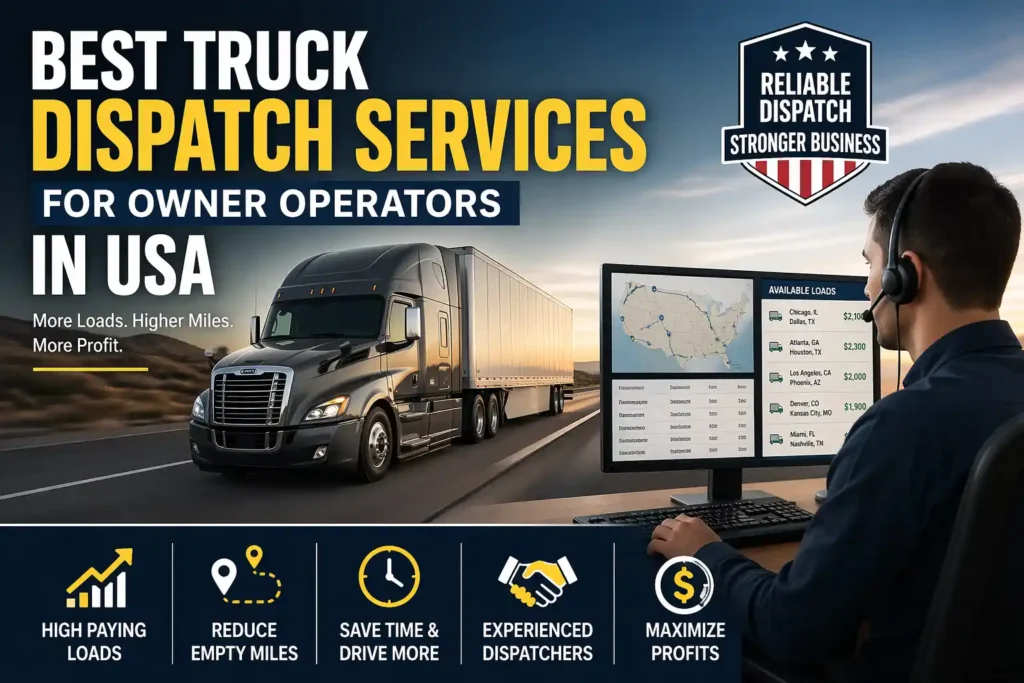
What is a truck dispatch service?
A truck dispatch service is a support service that assists truck drivers and owner operators with locating freight loads and securing them. Tasked with searching, negotiating, and making bookings, dispatchers are no longer using hours in load boards.
They have a straightforward occupation:
-
- Find available loads
-
- Contact brokers
-
- Negotiate rates
-
- Freight by truck your books.
-
- Handle basic paperwork
Simply put, they are intermediated, drivers and freight brokers.
Why owner operators need dispatch services
A lot of owner operators begin by thinking that they can do it all on their own. However, in the long run, the majority of them realize that it is a full-time job to find regular loads.
This is the actual use of dispatch services:
Saves time
You do not need to search loads all day, but instead you will be able to focus on driving and deliveries.
Better load access
Direct broker connections are often not available publicly on load boards and can only be provided by dispatchers.
Higher earning potential
An experienced dispatcher will think of how to get better freight rates.
Reduced empty miles
Fractionate dispatching makes you get backloads and limits deadhead movements.
Consistent work
Rather than random loads, you have more stable weekly routes.
What makes a good dispatch service?
Dispatch services are not all alike. Some are professional, seasoned, and others are mere novice load finders.
In a good dispatch service, we should find:
-
- Strong broker network
-
- Freight experience in various kinds.
-
- Clear communication
-
- Transparent pricing
-
- Skill in locating well-paying loads.
-
- Fixed assistance for your type of truck.
When a dispatcher cannot regularly supply loads, then what is the point?
Types of dispatch services for owner operators
This is because various trucks demand varying forms of dispatch support.
Box truck dispatching services.
Purposely used in Amazon relay and local freight, focused on local and regional delivery loads.
Flatbed dispatch services
Specializes in heavy and oversized freight like construction materials and equipment.
Hotshot dispatch services.
Pickup trucks with trailers are used to load fast delivery loads, which may be time-sensitive freight.
Reefer dispatch services
During the transportation of products under a certain temperature (food and pharmaceuticals).
Dry van dispatch service.
One of the most prevalent ones is transporting general freight interstate.
How dispatch services help increase profits
A good dispatching service is not one that simply locates loads. It has a direct effect on your income.
They help by:
-
- Finding higher-paying lanes
-
- Avoiding low-rate brokers
-
- Planning efficient routes
-
- Reducing fuel waste
-
- Booking backhaul loads
A single percent change in rate per mile can result in a huge rise in monthly earnings.
Common mistakes owner operators make
Too many drivers can not work not due to the absence of work, but due to the miscalculations:
-
- Taking low loads too readily.
-
- Collaborations with inexperienced dispatchers.
-
- Using a single source of load.
-
- Failure to plan the return trips.
-
- Not considering fuel and route efficiency.
These are some of the mistakes that should be avoided to contribute significantly to profitability.
How to choose the best truck dispatch service in USA
Check: Before working with any dispatch company, examine:
Experience
The length of time that they have been in the trucking industry.
Load network
The existence of strong relationships with brokers and shippers.
Transparency
Proper definition of fees and commission system.
Communication
Quick reaction and adequate movement updates on loads.
Results
Potential to supply regular and lucrative loads.
Conclusion
A good dispatch service is more than a support tool to owner operators in the USA: it can be a business partner. It not only curbs downtime but also improves the quality of loads and overall profits.
The thing, though, is selecting the appropriate dispatcher. One feeble service will cost you time, and a good one will always get your truck going and make you a profit.
Assuming that you want consistent traffic and improved revenues, then one of the most efficient dosses that you can take in the trucking sector is to engage a solid dispatch service.