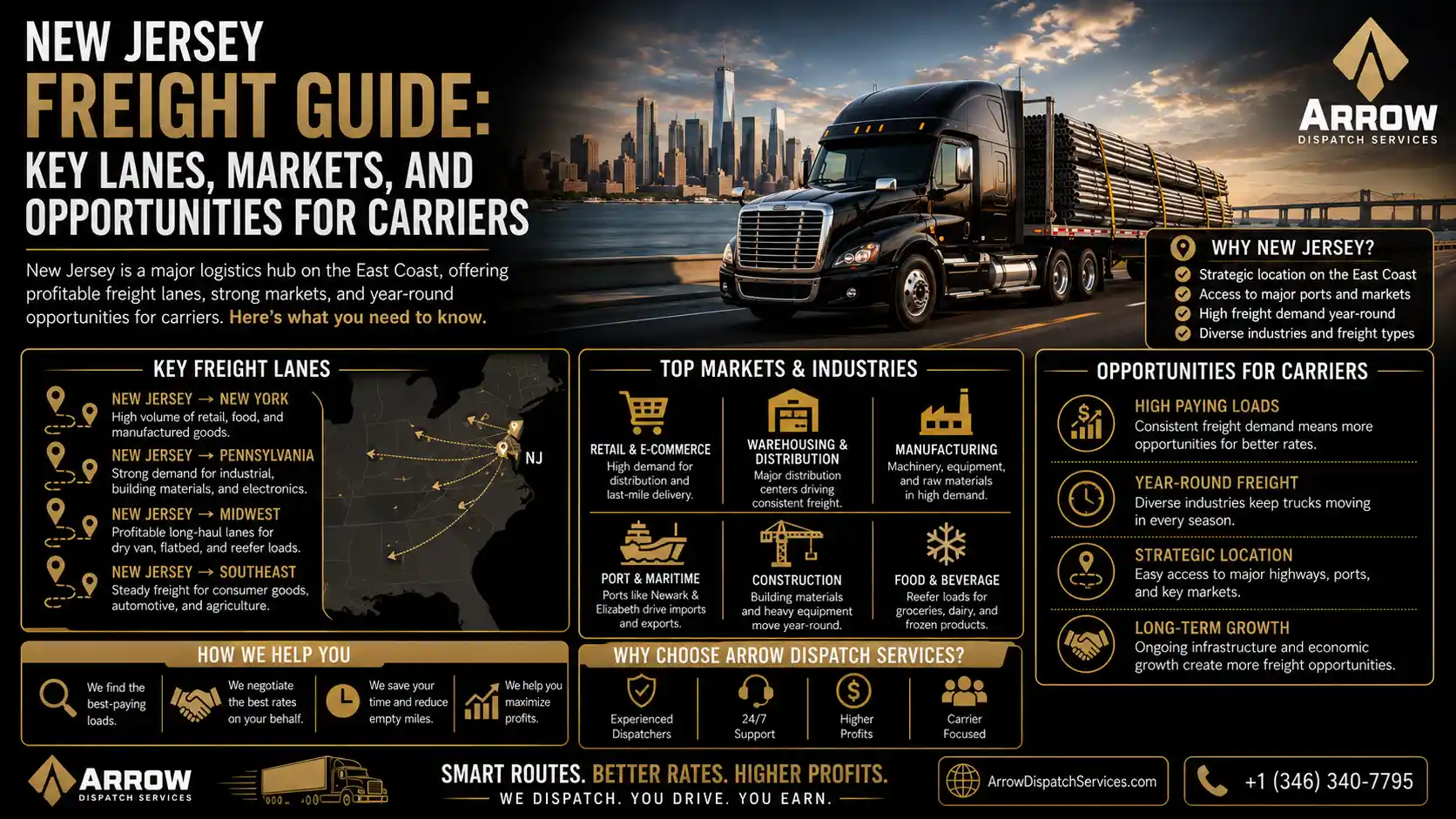
New Jersey is one of the most important freight markets on the East Coast. Its location gives carriers access to the New York City and Philadelphia metropolitan areas, major highways, ports, rail networks, airports, and large distribution centers.
For owner-operators and small fleets, this creates opportunities for local, regional, and long-haul freight. But New Jersey can also be challenging because of congestion, tolls, dense urban areas, tight delivery schedules, and high operating costs.
Understanding the state’s major freight markets and lanes can help carriers choose loads more carefully and improve their overall profitability.
Why New Jersey Is Important for Trucking
New Jersey sits between two of the largest consumer markets in the country: New York and Philadelphia. The state also has an extensive multimodal freight network covering highways, rail, marine terminals, airports, and pipelines.
Northern New Jersey is especially important for distribution. The region includes the Port of New York and New Jersey, major rail facilities, Newark Liberty International Airport, and a large concentration of industrial properties. Trucking handles roughly 70% of the freight moved in the NJTPA region.
This makes New Jersey a valuable market for dry van, reefer, flatbed, box truck, drayage, and other types of carriers.
Major Freight Markets in New Jersey
Newark
Newark is one of the state’s most important freight locations because of its proximity to the Port of New York and New Jersey and Newark Liberty International Airport.
Carriers can find freight connected to:
- Imports and exports
- Consumer goods
- Retail products
- Distribution
- Air cargo
- Manufacturing
The location can be attractive for carriers looking for connections between port freight and regional distribution centers.
Elizabeth
Elizabeth is closely connected to the Port of New York and New Jersey and surrounding industrial areas.
Freight activity can include:
- Containerized cargo
- Retail merchandise
- Consumer products
- Industrial goods
- Imported products
Carriers working around the port should plan carefully for appointment times, terminal procedures, traffic, and potential waiting time.
Secaucus and Meadowlands
The Meadowlands area provides access to major population centers in northern New Jersey and New York.
The region is well positioned for distribution and last-mile freight because of its proximity to dense consumer markets.
Edison and Central New Jersey
Central New Jersey is a major distribution area with warehouses and industrial facilities located around key transportation corridors.
Edison and surrounding communities can provide opportunities for:
- Retail freight
- E-commerce
- Consumer products
- General merchandise
- Regional distribution
Cranbury and South Brunswick
The Central Jersey area around Cranbury and South Brunswick is another important logistics market.
Warehousing and distribution facilities in this region serve customers throughout the Northeast.
For carriers, these locations can provide useful outbound and regional freight opportunities.
Camden and South Jersey
South Jersey has its own significant freight network. The South Jersey Port Corporation operates freight facilities in Camden, Paulsboro, and Salem, supporting bulk, breakbulk, and other cargo movements.
The region also has major distribution activity along the New Jersey Turnpike, I-295, and Route 130 corridors.
Major Freight Lanes From New Jersey
New Jersey’s location makes it a strong starting point for freight moving throughout the Northeast, Mid-Atlantic, and beyond.
New Jersey to New York
The New Jersey-New York lane is one of the busiest regional freight connections.
Common freight includes:
- Retail products
- Consumer goods
- Food
- E-commerce shipments
- General merchandise
The short distance can allow multiple deliveries, but congestion and traffic can significantly affect driving time.
New Jersey to Pennsylvania
Pennsylvania is an important outbound market for New Jersey carriers.
Philadelphia and surrounding areas provide access to distribution centers, manufacturing facilities, and consumer markets.
This can be a useful regional lane for carriers looking to avoid longer interstate trips.
New Jersey to New England
Carriers can move freight from New Jersey toward:
- Connecticut
- Massachusetts
- Rhode Island
- New Hampshire
- Maine
New England destinations can provide strong consumer and distribution demand, although carriers should account for distance, tolls, traffic, and return freight.
New Jersey to Maryland and Virginia
The Mid-Atlantic corridor connects New Jersey with major markets in Maryland and Virginia.
Potential destinations include Baltimore, Washington, D.C., and Northern Virginia.
This lane can be useful for dry van and reefer carriers serving retail, food, manufacturing, and distribution customers.
New Jersey to North Carolina
North Carolina is an important manufacturing and distribution market.
Freight moving between New Jersey and North Carolina can connect Northeast consumers with Southern manufacturing and distribution centers.
Before accepting a load, compare the outbound rate with the availability of freight near your delivery location.
New Jersey to Georgia
Atlanta is one of the largest freight hubs in the Southeast.
New Jersey-to-Georgia freight can provide a long-haul opportunity for carriers looking to move south.
The key consideration is the return trip. A strong outbound rate can lose its appeal if the carrier has to deadhead back toward the Northeast.
Freight Types Common in New Jersey
Dry Van Freight
Dry van is one of the most flexible equipment types for New Jersey freight.
Carriers may find:
- Retail goods
- Consumer products
- Packaged food
- E-commerce freight
- General merchandise
- Manufacturing products
New Jersey’s large distribution network makes dry van freight particularly relevant to the region.
Reefer Freight
Refrigerated carriers can find opportunities involving:
- Produce
- Frozen food
- Dairy products
- Meat
- Temperature-sensitive goods
South Jersey has agricultural and seafood activity, while the state’s distribution network serves major population centers.
Reefer carriers should carefully confirm temperature requirements, appointment times, detention terms, and loading procedures.
Flatbed Freight
Flatbed carriers can target:
- Steel
- Lumber
- Machinery
- Construction materials
- Industrial equipment
- Building products
Flatbed operators should account for securement, tarping, loading time, and accessorial charges when calculating profitability.
Box Truck Freight
Box trucks can find opportunities in:
- Local deliveries
- Retail distribution
- Furniture
- Appliances
- Last-mile freight
- Business deliveries
The large population centers around northern and central New Jersey can create demand for shorter-distance delivery work.
New Jersey Port Freight
The Port of New York and New Jersey is a major international gateway for the region. The 2023 New Jersey Statewide Freight Plan describes it as the largest container port on the Atlantic Coast and a critical gateway to the concentrated New York-New Jersey consumer market.
Port-related trucking can include:
- Container drayage
- Warehouse transfers
- Import deliveries
- Export shipments
- Transloading
- Distribution freight
Port work can be profitable, but carriers should understand terminal procedures, appointment systems, chassis requirements, detention policies, and other operating details before entering the market.
New Jersey Rail Freight
New Jersey also has an extensive freight rail network. The state has more than 1,300 miles of freight rail connected to national and international rail systems.
Rail connections create opportunities for intermodal trucking and freight movement between rail terminals, warehouses, distribution centers, and customers.
How to Find Freight in New Jersey
Carriers can use several methods to find loads.
Load Boards
Load boards can help you identify available freight based on:
- Origin
- Destination
- Equipment
- Weight
- Mileage
- Rate
Always confirm the complete load details before booking.
Freight Brokers
Brokers can connect carriers with shippers that need transportation.
When speaking with a broker, confirm:
- Rate
- Commodity
- Weight
- Pickup appointment
- Delivery appointment
- Detention terms
- Accessorial charges
- Payment terms
Direct Shippers
Building direct relationships with New Jersey manufacturers, retailers, distributors, and warehouses can provide repeat freight opportunities.
Direct customers can be especially valuable for carriers trying to reduce their dependence on one-time loads.
Dispatch Services
A professional truck dispatcher can search for freight, contact brokers, negotiate rates, coordinate appointments, and help plan reloads.
For owner-operators, dispatch support can reduce the amount of time spent searching for the next load.
Challenges of Trucking in New Jersey
New Jersey offers plenty of freight, but it also has operational challenges.
Traffic
Heavy traffic around New York City, Newark, Elizabeth, and other urban areas can make delivery times unpredictable.
Tolls
Tolls can add significant costs to certain routes. Include them when calculating your expected profit.
Parking
Truck parking can be difficult in busy freight corridors, so drivers should plan ahead rather than waiting until the end of their hours to find a safe place to stop.
Congestion at Freight Facilities
Ports, warehouses, and distribution centers can experience delays. Ask about appointment requirements and expected loading or unloading procedures before accepting a shipment.
Tight Delivery Windows
Some Northeast customers operate on strict appointment schedules. Build enough time into your route plan to account for traffic and unexpected delays.
How to Choose Profitable New Jersey Freight
Do not choose a load based only on the advertised rate.
Look at:
- Total miles
- Deadhead
- Fuel
- Tolls
- Loading time
- Unloading time
- Equipment requirements
- Destination
- Reload opportunities
- Delivery schedule
A $1,000 load with heavy congestion and large amounts of unpaid waiting time may be less profitable than a lower-paying load with a shorter route and faster turnaround.
Reduce Deadhead in New Jersey
Deadhead can quickly reduce your actual revenue per mile.
To reduce empty miles:
- Search for reloads before delivery
- Monitor nearby freight markets
- Build broker relationships
- Develop direct shipper accounts
- Use load boards strategically
- Work with a dispatcher if needed
Planning the next load before completing the current one can help keep your truck productive.
Final Thoughts
New Jersey is a major freight market with strong connections to New York, Philadelphia, New England, the Mid-Atlantic, the Southeast, and national supply chains. Its ports, warehouses, rail facilities, airports, and highway network create opportunities for many types of carriers.
The best opportunity depends on your equipment, preferred lanes, operating costs, and ability to find profitable reloads.
If you operate in New Jersey, focus on the complete economics of each load rather than simply chasing the highest rate. Control deadhead, account for tolls and traffic, plan deliveries carefully, and build relationships with reliable brokers and direct customers.
Frequently Asked Questions
Why is New Jersey important for freight?
New Jersey connects major New York and Philadelphia markets and has extensive highway, rail, port, and air freight infrastructure.
What are the major freight areas in New Jersey?
Newark, Elizabeth, Edison, South Brunswick, Cranbury, Secaucus, Camden, and other areas throughout North and Central Jersey are important freight and distribution markets.
What freight is common in New Jersey?
Common freight includes retail goods, consumer products, food, manufacturing materials, imported goods, industrial products, and e-commerce shipments.
Is New Jersey good for dry van carriers?
Yes. The state’s large distribution and consumer markets create opportunities for general freight and dry van carriers.
Are there reefer loads in New Jersey?
Yes. Food, produce, frozen goods, and other temperature-sensitive freight create opportunities for refrigerated carriers.
What are good freight lanes from New Jersey?
Common lanes connect New Jersey with New York, Pennsylvania, New England, Maryland, Virginia, North Carolina, and Georgia. Profitability changes with current freight rates and reload availability.
Is port trucking profitable in New Jersey?
Port trucking can provide strong opportunities, but carriers need to account for terminal procedures, congestion, chassis availability, appointment requirements, tolls, and waiting time.
How can I find New Jersey truck loads?
You can use load boards, freight brokers, direct shippers, delivery contractors, and professional dispatch services to find suitable freight.
How can a dispatcher help New Jersey carriers?
A dispatcher can search for loads, negotiate rates, communicate with brokers, schedule pickups and deliveries, and look for reload opportunities.
What should I consider before taking a New Jersey load?
Consider the total rate, loaded and empty miles, fuel, tolls, traffic, appointment times, loading and unloading delays, equipment requirements, and the availability of your next load.