Today’s freight market can be over whelming for U.S. owner-operators with its choices and confusion. You can use load boards, or not. Hire a dispatcher? Develop a sales force of direct brokers? Or mix all three? While each option offers potential gains, there are trade-offs to consider that may affect your bottom line, time, and sanity.
Devoting too much time to searching for freight – or too much money to a product that doesn’t pay off? Time to shuffle over.
So, based on today’s pricing stages, real-world outcomes, and industry research, here are the advantages, disadvantages, and ideal applications for load boards, dispatch services, and freight brokers.
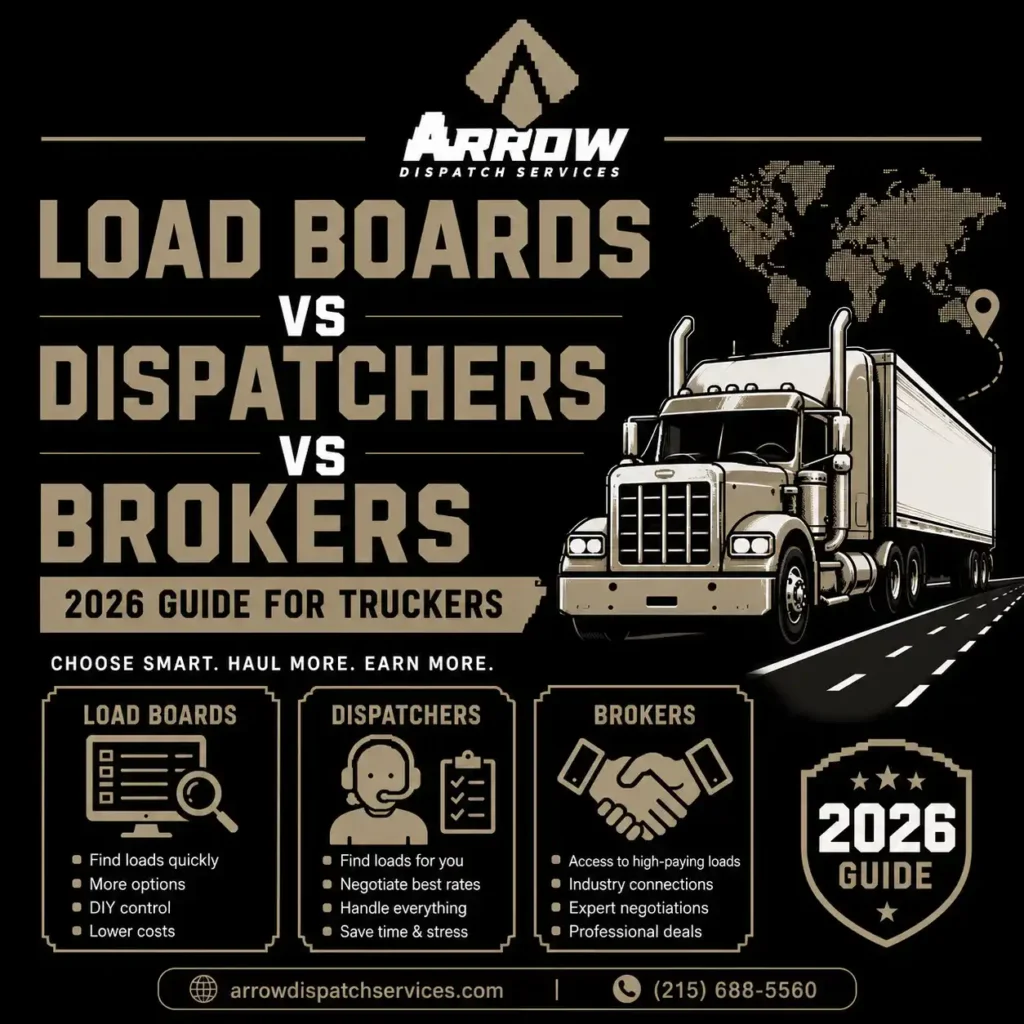
Load Boards Tools and Costs
For many owner-operators, load boards remain a staple tool. There are thousands of loads available per day on platforms such as DAT One, Truck stop, and 123 Load board. They include features such as rate analytics, credit score tools, and, in the past few years, “Book Now” and mobile apps.
The problem with that, however, is that boards are highly competitive – and they also provide great flexibility and visibility. Everyone is seeing the same loads – also in many cases simultaneously! As a new authority, it may be difficult for you to get noticed. Not to mention all the time spent updating listings, calling brokers, and completing paper work? It adds up fast.
For 2026, the plan is to offer discounted board subscriptions ranging from $50 to $180 per month, based on the features required. Many carriers run multiple boards, and monthly spend ranges from $150 to $300. Not to mention the unpaid time spent booking, which can easily add up to over 10 hours a week for sole traders.
Dispatch Services: Time-Savers with Strategic Impact
Having a dispatcher can come across as a ‘cheat code’ – someone else does the work while you sit in the cab. Dispatchers usually find loads, negotiate rates, handle paperwork, and design backhauls. They may even offer to enforce detention pay and schedule a course of action with the broker(s) so you do not need to.
Most dispatchers require a commission of 5-10% of your gross, or a fixed commission of $75-$150 per load. At $8,000 per week, this can be $400-$800 — a worthwhile investment that could be particularly important. Many carriers state that dispatchers not only save hours a week (10+), but also consistently load better-paying freight and reduce empty miles.
Great dispatch services are your freight strategist, constantly monitoring rate trends, identifying backhaul opportunities, and being better informed to adapt to a changing market. With a good team in your space, you’re not just outsourcing the admin, you’re accessing greater efficiency and better planning.
All dispatch services are not the same.
Unlike load boards and transactional brokers, Arrow Dispatch Services is a company that acts as a broker for other companies. The focus isn’t volume or speed – it’s alignment. Before the driver sees it, loads are assessed based on your actual cost per mile, lane balancing, and exit risk.
Freight Brokers: Margins, and Use Cases
Licensed intermediaries are freight brokers. They are a link between shippers and carriers and often determine access to contract freight, not the type of freight that makes frequent jumps on public boards. In a tight or inverted market, like the one we’ve experienced in 2025, contract prices may be more attractive than spot prices.
Carriers have no deal with brokers. Instead, they factor in their commission – usually in the 15-18% range – to your pay rate. If the shipper’s paying $2.20/mi, you might get $1.85/mi. For that, you can enjoy more consistent freight, more stable lanes, and a lower deadhead percentage.
It’s all about reputation. Carriers that arrive on time, maintain safety, and are good communicators are the carriers that brokers want. Less desirable loads may be offered to new carriers until they become established. However, after you gain the opportunity to trade in a broker’s “core” rotation, you will be able to see increased rates and consistency aside from searching for spots each day.
Red Flags and Industry Risks
There are a lot of scams in the trucking world – and 2024-2025 isn’t lacking:
- Fake dispatchers that claim to require some form of up-front fee or have “exclusive shipper access.”
- Board-loads with double brokering, paying, and legal risk.
- Vague broker fees, hidden fees such as fake lumper fees.
- FMCSA Broker Transparency Rule (NPRM 2024) proposed by CMS to make brokers report the transaction records within 48 hours.
What’s the Best Freight Strategy for 2026?
There are no one-size-fits-all type answers, but there are patterns.
Start with load boards to learn lanes, acquire a history, and schedule your own time as a new owner-operator. Time and pay record keeping.
If you’re feeling overwhelmed by admin or grossing $6K/week, you may need to scale up and add a dispatcher to get strategic.
Remove any unfounded fear of the unknown. At 6–12 months in, start building relationships with 2–3 consistent brokers. Provide neat paperwork, arrive on time, and request special lanes.
In the long run, it’s the hybrid route that the victor:
- Fill in gaps and ride the hot lanes using load boards
- A Dispatcher helps with more efficient planning and frees up the administration!
- Utilize brokers for steady freight and increased utilization.
The most savvy owner-operators don’t just know their gross income; they understand time, cost, and loaded miles. If you’re spending 10+ hours per week on the booking process and still aren’t fully booked, it’s time to rethink your strategy!
They realize that without sequencing and organizing the reloads, great loads don’t necessarily make for great weeks.
Final Thoughts: Don’t Just Chase Loads. Build a Strategy.
Scrappy vs Scalable: It isn’t just about hustle in 2026 – it’s about strategy. Making the smart selection of your freight-finding mix can help you eliminate waste, achieve a consistent income, and reclaim your time.
Fewer tools are better than operational clarity.
The most successful owner-operators can’t depend on a single freight source. They create a system that is flexible, consistent, and time-efficient on the road.
Arrow dispatch services is not for the operator who’s only concerned about dispatch support; it’s for the company operator who strives to integrate it into a broader structure, is cost-conscious, and wants longevity.
In the case of owner operators in the USA, it is more difficult to find steady and well-compensated loads than the actual driving of the truck. The competition is intense, the brokers are quick, and any good freight will hardly have a lengthy shelf life. Here is where dispatch services are involved. An experienced dispatcher could save some money, lessen dead air miles and enable you to drive more rather than drive all day trying to locate loads.
This guide defines exactly what truck dispatch services are, why they are important to owner operators and how to select the one that fits best in your trucking industry.
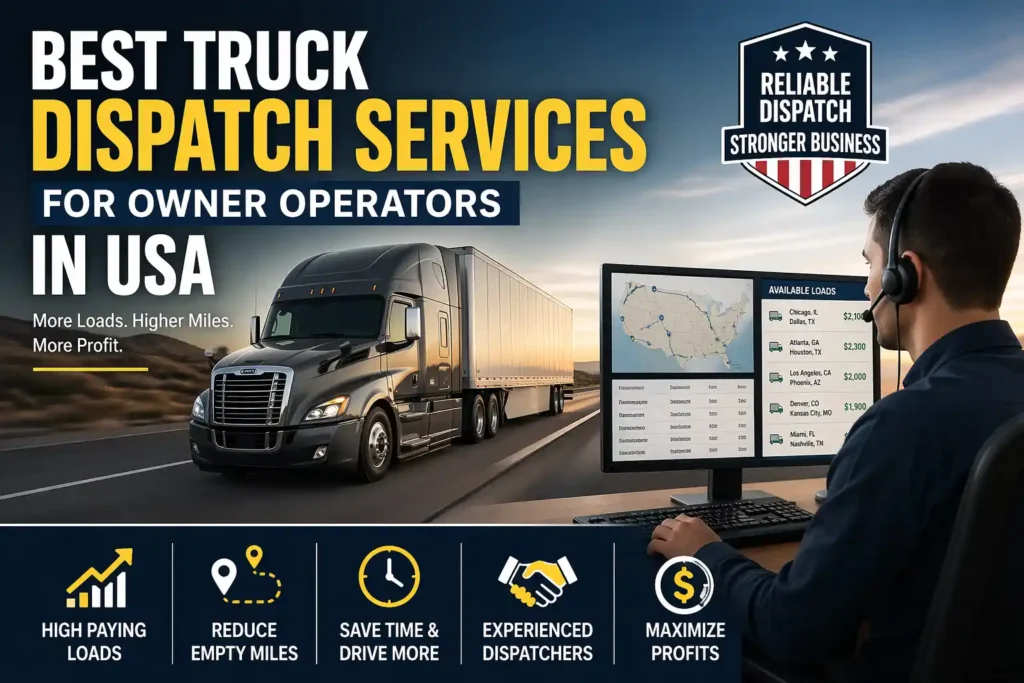
What is a truck dispatch service?
A truck dispatch service is a support service that assists truck drivers and owner operators with locating freight loads and securing them. Tasked with searching, negotiating, and making bookings, dispatchers are no longer using hours in load boards.
They have a straightforward occupation:
-
- Find available loads
-
- Contact brokers
-
- Negotiate rates
-
- Freight by truck your books.
-
- Handle basic paperwork
Simply put, they are intermediated, drivers and freight brokers.
Why owner operators need dispatch services
A lot of owner operators begin by thinking that they can do it all on their own. However, in the long run, the majority of them realize that it is a full-time job to find regular loads.
This is the actual use of dispatch services:
Saves time
You do not need to search loads all day, but instead you will be able to focus on driving and deliveries.
Better load access
Direct broker connections are often not available publicly on load boards and can only be provided by dispatchers.
Higher earning potential
An experienced dispatcher will think of how to get better freight rates.
Reduced empty miles
Fractionate dispatching makes you get backloads and limits deadhead movements.
Consistent work
Rather than random loads, you have more stable weekly routes.
What makes a good dispatch service?
Dispatch services are not all alike. Some are professional, seasoned, and others are mere novice load finders.
In a good dispatch service, we should find:
-
- Strong broker network
-
- Freight experience in various kinds.
-
- Clear communication
-
- Transparent pricing
-
- Skill in locating well-paying loads.
-
- Fixed assistance for your type of truck.
When a dispatcher cannot regularly supply loads, then what is the point?
Types of dispatch services for owner operators
This is because various trucks demand varying forms of dispatch support.
Box truck dispatching services.
Purposely used in Amazon relay and local freight, focused on local and regional delivery loads.
Flatbed dispatch services
Specializes in heavy and oversized freight like construction materials and equipment.
Hotshot dispatch services.
Pickup trucks with trailers are used to load fast delivery loads, which may be time-sensitive freight.
Reefer dispatch services
During the transportation of products under a certain temperature (food and pharmaceuticals).
Dry van dispatch service.
One of the most prevalent ones is transporting general freight interstate.
How dispatch services help increase profits
A good dispatching service is not one that simply locates loads. It has a direct effect on your income.
They help by:
-
- Finding higher-paying lanes
-
- Avoiding low-rate brokers
-
- Planning efficient routes
-
- Reducing fuel waste
-
- Booking backhaul loads
A single percent change in rate per mile can result in a huge rise in monthly earnings.
Common mistakes owner operators make
Too many drivers can not work not due to the absence of work, but due to the miscalculations:
-
- Taking low loads too readily.
-
- Collaborations with inexperienced dispatchers.
-
- Using a single source of load.
-
- Failure to plan the return trips.
-
- Not considering fuel and route efficiency.
These are some of the mistakes that should be avoided to contribute significantly to profitability.
How to choose the best truck dispatch service in USA
Check: Before working with any dispatch company, examine:
Experience
The length of time that they have been in the trucking industry.
Load network
The existence of strong relationships with brokers and shippers.
Transparency
Proper definition of fees and commission system.
Communication
Quick reaction and adequate movement updates on loads.
Results
Potential to supply regular and lucrative loads.
Conclusion
A good dispatch service is more than a support tool to owner operators in the USA: it can be a business partner. It not only curbs downtime but also improves the quality of loads and overall profits.
The thing, though, is selecting the appropriate dispatcher. One feeble service will cost you time, and a good one will always get your truck going and make you a profit.
Assuming that you want consistent traffic and improved revenues, then one of the most efficient dosses that you can take in the trucking sector is to engage a solid dispatch service.