The first step that most owner operators take is to dispatch themselves. In the beginning, it sounds logical. You are your own master, dealing directly with the load owner and do not pay a dispatch fee. In the first few months in particular, self-dispatch might be the most appropriate arrangement for one truck motor team.
The issue is self dispatch doesn’t just stop. As the operation becomes more complex, it gradually doesn’t work. True story: It isn’t actually whether dispatch is useful. It’s this:
When does self-dispatch stop being consistent and a good way to earn income?
What Self-Dispatch Actually Involves
The term self-dispatch is used a lot to refer to “finding loads”; however, that label is used but falls short of what is really meant.
The actual process is one that is ongoing and is located between driving and operations. Every time the truck stops for a load, each stop has a cascading effect on subsequent stops – where the truck will be, how long it will take to be loaded and how the week will get structured!
The ingredients of a typical self-dispatched operation are:
- Figure out how to search and filter query loads on platforms
- clearance rates, working out rates with agents
- Timing of planning reloads and market positioning (CFOE)
- D | Communication management on transport.
- Paperwork, confirmations and updates
- This can be done at a small scale. Easy operation, limited lanes and opinions are easier to manage.
There are three levels of complexity, getting more challenging as the activity becomes more frequent. As a broker opens more markets, more timing implications and more brokers, it becomes more difficult to keep this in sync. Beyond that, self-dispatch ceases to be a chore and becomes a function that overlays driving, an operational function.
The First Sign: Revenue Becomes Inconsistent
There is no easy failure mode for self-dispatch. It degrades gradually.
Most on-the-road drivers detect it by the irregular pattern. One week it does great; the next week not quite so great; the next week great—no known trend or pattern. The lack of freight is not the problem; it is the inability to reproduce a stable week.
See how much revenue can be gained or lost with even one or two days of delay between loads, according to ATRI metrics.
The loss is seldom related to a poor load and generated from the time between loads, which was neither planned nor controlled.
Many owner operators take the approach of doing more at this point. We call more, search more & spend more time on load boards. However, there is no corresponding increase in output due to the changed constraint. It’s all about effort; it is now about structure.
Why This Happens (And Why It’s Not a Load Problem)
Consistent weeks are the exception, and it is automatically assumed that the market is to blame when a week is inconsistent. Generally, these are caused by sequencing in practice.
With self-dispatch, it’s only natural that it would be the next available load. This is a short-term solution, and in the longer term, it may cause fragmentation. One by one, load decision-making leads to trucks offloading in poorer markets, reactive load times, and positions slowly degrade over time.
Small carriers are frequently up to 15-20% empty miles, as per ATRI data. In a lot of situations, that is not because there is not enough freight, but it simply stems from load matching for the week.
This is someplace where most operators get stuck. They have no difficulties in finding freight. Are you having trouble connecting loads?
This is precisely the same move detailed in How Weekly Planning Beats “Good Load” Thinking Every Time – When you change the load moving methods from individual loads to structuring the complete week.
Negotiation Stops Scaling
During the initial phase, negotiation seems to be the most important aspect of self-dispatch. It’s clearly visible, easily measurable, and in your control.
Eventually, that leverage levels off. Not with the idea that negotiation is not going to work, but that negotiation does not work on the real constraints. There is no cure for poor positioning, poor lanes and no repeat broker relationships in a rate improvement.
Self-dispatched operators are usually able to do negotiations per individual load. That limits leverage.
There’s a different way dispatch services work. They relate to a variety of loads, brokers and lanes, enabling them to negotiate from a situation of continuity, not isolation.
This is the reason why two operators can have comparable rates and arrive at completely different results. One responds to freight that is available, the other works in a freight infrastructural field.
Planning Gaps Become the Bottleneck
The transition point typically isn’t overly dramatic. These look like small inefficiencies that pile up.
No consideration of the next market for loads. Last-minute searching of re-loads. Trucks head to areas of lesser interest. Deadhead increases.
Taken alone, each of these choices is insignificant. They work off for over a week. This is when the situation to be managed without structure becomes more difficult. Not that freight is not available, but it isn’t aligned.
The approach towards reload timing on consistent income is further discussed in Reload Timing Is the True Secret to Consistent Income.
Signs You’ve Outgrown Self-Dispatch
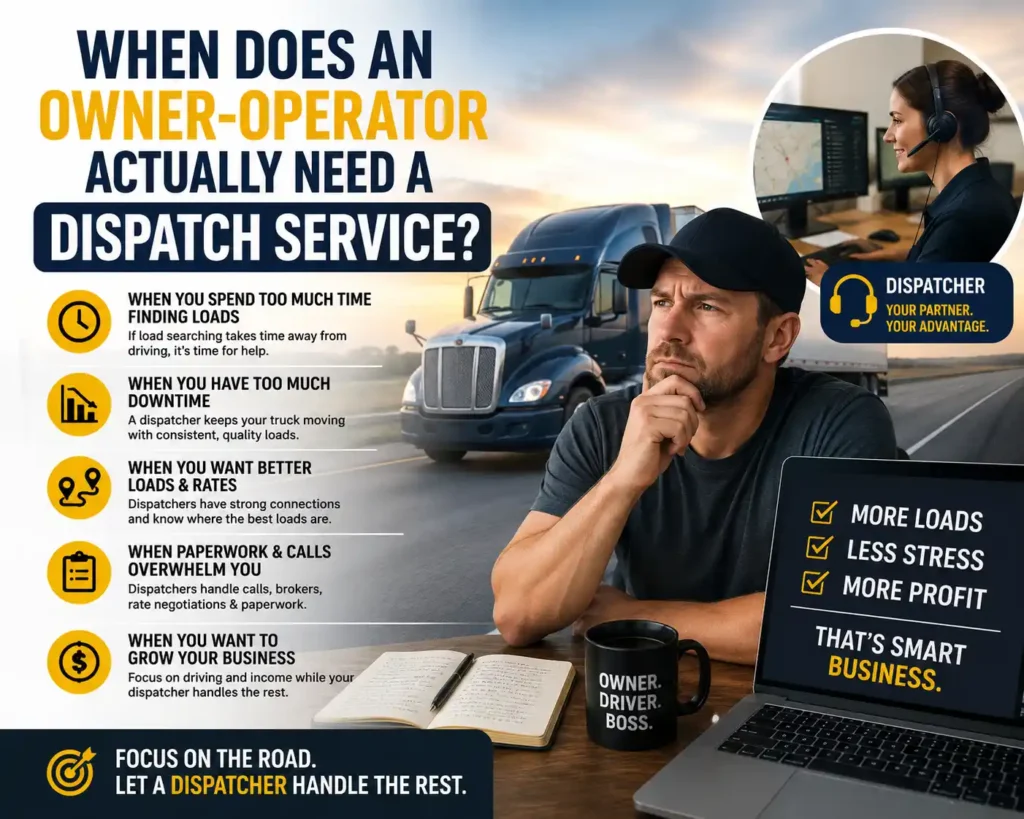
The majority of the owner operators do not require dispatch initially. However, there’s a point at which self-dispatching becomes inefficient. Common indicators include:
- It has no specific reason why weekly revenue changes and fluctuates.
- The driver is spending more time looking around than behind the wheel.
- Established in the strong weeks is not repeatable.
- The use of load boards is still extensively used
- Reload timings get out of sync.
These are not failures! These are signals that are useful in the structure. They say that this operation used to be a simple model and now requires some coordination and planning.
Dispatch Is an Operations Function
A major mistake is that folks believe dispatch is there to take the job of driving easier. In actuality, it is more an aspect of operations management as opposed to convenience.
It’s at dispatch where personal loads become a week. It shows the lanes and brokers used, the sequence in which the freight is being utilized, and how much the truck repeats old lanes and broker relationships.
That difference matters. A load is not booked correctly and can still result in a week being weak if this results in a truck being in the wrong market, or the next load is not loaded in time. Those minor misalignments add up to lost revenues over time.
That is why dispatch isn’t simply about booking loads… It’s about the relationship between loads over time. Highly functioning operations don’t depend on being able to find “better” freight; they depend on arranging for average freight to become predictable, repeatable weeks.
This is when a planned truck dispatch service begins to make sense, not as a luxury but to streamline the process of freight planning and execution throughout the week.
When Growth Starts Feeling Inconsistent
When everything is going great from an owner’s point of view, they don’t pay much attention to dispatch.
They consider it when weeks get tough – when loads are not lining up, schedules are thrown off, and resources aren’t as predictable for making income.
If you are at that stage, it could not be a load problem. Could be the management of the operation.
It’s possible to learn exactly how a truck dispatch service functions in reality, and have a look at what regular freight looks like.
In the case of owner operators in the USA, it is more difficult to find steady and well-compensated loads than the actual driving of the truck. The competition is intense, the brokers are quick, and any good freight will hardly have a lengthy shelf life. Here is where dispatch services are involved. An experienced dispatcher could save some money, lessen dead air miles and enable you to drive more rather than drive all day trying to locate loads.
This guide defines exactly what truck dispatch services are, why they are important to owner operators and how to select the one that fits best in your trucking industry.
What is a truck dispatch service?
A truck dispatch service is a support service that assists truck drivers and owner operators with locating freight loads and securing them. Tasked with searching, negotiating, and making bookings, dispatchers are no longer using hours in load boards.
They have a straightforward occupation:
-
- Find available loads
-
- Contact brokers
-
- Negotiate rates
-
- Freight by truck your books.
-
- Handle basic paperwork
Simply put, they are intermediated, drivers and freight brokers.
Why owner operators need dispatch services
A lot of owner operators begin by thinking that they can do it all on their own. However, in the long run, the majority of them realize that it is a full-time job to find regular loads.
This is the actual use of dispatch services:
Saves time
You do not need to search loads all day, but instead you will be able to focus on driving and deliveries.
Better load access
Direct broker connections are often not available publicly on load boards and can only be provided by dispatchers.
Higher earning potential
An experienced dispatcher will think of how to get better freight rates.
Reduced empty miles
Fractionate dispatching makes you get backloads and limits deadhead movements.
Consistent work
Rather than random loads, you have more stable weekly routes.
What makes a good dispatch service?
Dispatch services are not all alike. Some are professional, seasoned, and others are mere novice load finders.
In a good dispatch service, we should find:
-
- Strong broker network
-
- Freight experience in various kinds.
-
- Clear communication
-
- Transparent pricing
-
- Skill in locating well-paying loads.
-
- Fixed assistance for your type of truck.
When a dispatcher cannot regularly supply loads, then what is the point?
Types of dispatch services for owner operators
This is because various trucks demand varying forms of dispatch support.
Box truck dispatching services.
Purposely used in Amazon relay and local freight, focused on local and regional delivery loads.
Flatbed dispatch services
Specializes in heavy and oversized freight like construction materials and equipment.
Hotshot dispatch services.
Pickup trucks with trailers are used to load fast delivery loads, which may be time-sensitive freight.
Reefer dispatch services
During the transportation of products under a certain temperature (food and pharmaceuticals).
Dry van dispatch service.
One of the most prevalent ones is transporting general freight interstate.
How dispatch services help increase profits
A good dispatching service is not one that simply locates loads. It has a direct effect on your income.
They help by:
-
- Finding higher-paying lanes
-
- Avoiding low-rate brokers
-
- Planning efficient routes
-
- Reducing fuel waste
-
- Booking backhaul loads
A single percent change in rate per mile can result in a huge rise in monthly earnings.
Common mistakes owner operators make
Too many drivers can not work not due to the absence of work, but due to the miscalculations:
-
- Taking low loads too readily.
-
- Collaborations with inexperienced dispatchers.
-
- Using a single source of load.
-
- Failure to plan the return trips.
-
- Not considering fuel and route efficiency.
These are some of the mistakes that should be avoided to contribute significantly to profitability.
How to choose the best truck dispatch service in USA
Check: Before working with any dispatch company, examine:
Experience
The length of time that they have been in the trucking industry.
Load network
The existence of strong relationships with brokers and shippers.
Transparency
Proper definition of fees and commission system.
Communication
Quick reaction and adequate movement updates on loads.
Results
Potential to supply regular and lucrative loads.
Conclusion
A good dispatch service is more than a support tool to owner operators in the USA: it can be a business partner. It not only curbs downtime but also improves the quality of loads and overall profits.
The thing, though, is selecting the appropriate dispatcher. One feeble service will cost you time, and a good one will always get your truck going and make you a profit.
Assuming that you want consistent traffic and improved revenues, then one of the most efficient dosses that you can take in the trucking sector is to engage a solid dispatch service.