Best Freight Types for Flatbed Trucking (With Real-World Examples & Case Studies)
Flatbed trucking is one of the most versatile and profitable sectors in U.S. logistics. From steel beams to farm machinery, flatbeds move the freight that keeps industries alive — heavy, oversized, or oddly shaped loads that no other trailer type can handle.
But the question most drivers and small fleet owners ask is:
What are the most profitable freight types ideal for flatbed trucking, and how can I get them consistently?
Types of cargo that are most profitable through flatbed trucking are the construction materials, heavy machinery, pipes, agricultural machinery, and oversized cargo. The pay is good in these loads as they need skill, security and specialized equipment.
Why Flatbed Trucking Matters More Than Ever?
What Makes Flatbed Hauling Unique?
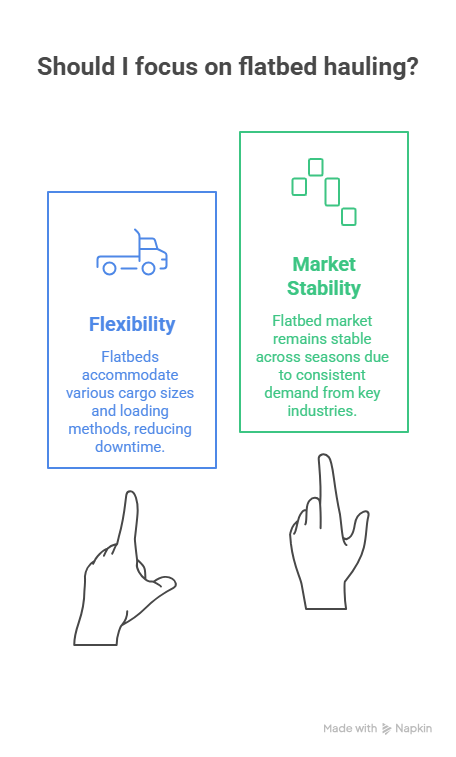
The horses of open deck hauling are the flatbeds. They do not limit freight based on height or width like dry vans do. Cargoes can be loaded on the sides or on the top by use of cranes or forklifts thus shortening the loading process and minimizing downtimes.
To the carriers, this flexibility implies increased opportunities. The reefer or dry-van market goes up and down with the season, whereas the flatbed market remains stable construction, energy, and agriculture all require it.
Heavy and Oversized Cargo Advantages.
An average 48-foot flatbed will hold approximately 48,000 pounds — again, with the right permits it will be much more. The trailers are easy to carry huge, long, or unusual loads. The cargo is safe in terms of tarps, chains, and straps, regardless of the weather.
Loads on Construction Materials and Steel.
The Backbone of Every Build
Rebar, steel beams, lumber and concrete slabs constitute the workhorse of the American economy. Almost all infrastructures and commercial ventures depend on flatbed trucking in the transportation of raw material.
Why Flatbeds Work Best?
Loading docks are not common in construction sites. Flatbeds can be loaded sideways or at the top with ease which saves time and congestion at the location. These materials are very strong and hence they do not need enclosed trailers.
Case Study.
On the Ohio side, one of the 5-truck fleets collaborated with a flatbed dispatching company, focusing on construction loads of regional brokers. After three months, they had reported:
- 22% higher revenue per mile
- 40% fewer deadhead miles
- Regular loads on return-lanes carrying steel and lumber.
The key? Their dispatcher concentrated on the lane-based planning, and aligned their trucks with the frequent construction suppliers – a typical example of dispatching well accomplished.
Industrial Machinery and Heavy Equipment.
Moving Giants on Wheels
Industrial machinery is usually bigger than the normal size, such as factory presses, generators, bulldozers, etc. Such loads must be secured, a subject that demands expertise in route planning and in some instances special permits which flatbeds excel.
Why Flatbeds Are Ideal?
Access and flexibility of large and irregular shapes are offered by flatbeds. An organized dispatcher is the one who makes sure that drivers get the appropriate load that fits their equipment specifications – saves them time, eliminates compliance problems, and maximizes income.
Case Study: Texas Heavy-Haul owner operator.
An owner-operator who had been working with a load dispatch team with experience in heavy equipment loads, based in Texas, switched to flatbed. Within two months:
- His mean RPM (Rate Per Mile) increased to 3.70 as compared to 2.35.
- He started to create short-haul load of machinery between Houston and Dallas.
- With back-to-back load scheduling, downtime reduced by half.
Coordination of dispatching turned out to be the key – locating loads of machinery that matched his equipment profile and favourable lanes.
Pipes, Tubing and Long Industrial Components.
The Challenge of Length
Such industries as oil, gas and water utilities are based on the extensive use of pipes and tubing – freight that may be more than 50 feet long. These loads are not easy to balance and secure.
The Flatbed Solution to the Problem.
The fact that they can have extendable and step-deck flatbeds enables carriers to transport extra-long materials safely. Even the most awkward of lengths may be easily moved with the proper tie-down arrangement and spacing.
Real-life Case Study: Energy Sector Freight.
In North Dakota, the oilfield carriers also rely on the use of flatbeds to transport the long steel pipes to the drilling scenes. Energy freight dispatchers liaise with brokers to ensure that they have predictable contracts that attract high rates. These associations usually result in many-month contracts – the steady earnings in the low freight seasons in other areas.
Farm Machinery and Agricultural equipment.
Feeding the World Flatbeds.
The other foundation of flatbed freight is agriculture. Tractors and harvesters, irrigation systems and feed containers are some of the bulky machines that keep the farms moving and they cannot fit into any enclosed trailer.
Why Flatbeds Are the Go-To
Rural logistics are simplified using Flatbeds. They can be loaded and offloaded in the open fields, into warehouses or repair shops without the use of a dock. Freight volume spikes during the planting and harvest seasons which provide high-paying loads.
Case Study:
In Iowa a 3-truck carrier started to specialize on agricultural loads. Having partnered with one of the truck dispatch service providers, they obtained agreements with the local equipment dealers. The results:
- Weekly foreseeable loads that are seasonal.
- 30% higher average gross income
- Less time wastage between hauls.
This move enabled them to establish recurring relationships – a feat that smaller carriers have difficulty doing individually.
Excessive & Specialty Freight.
When Size Breaks the Rules
Large freight is larger than the legal size, which is normally over 8.5 feet or 13.5 feet. These loads require planning, permit and even escorting vehicles.
Why Flatbeds Excel
The flatbeds cannot be rivaled when it comes to the transportation of outpaced or non-constitutional freight, such as wind turbines or beam bridges. Their open design enables the carriers to carry large cargo in a safe way.
Carrier, Florida Case Study.
It was a Florida-based company which dealt in oversized commercial building HVAC units. Everything was done by their dispatching team including permits, escort coordination and negotiating with brokers. In terms of improved compliance management and improved routing:
- Their punctuality rate has increased to 97%.
- They minimized the risks of citation by one-half.
- Customers started to make their reservations without using brokers.
This shows that experienced dispatchers do not simply book loads, but rather that they construct sustainable operations.
Advantages of Flatbed Trucking Across Industries
Year-Round Demand
The industries of construction, agriculture and manufacturing maintain consistent freight throughout the year. Flat beds continue to operate even in case other freight markets are soft.
Flexible Loading
Flatbeds can be loaded on the side, rear or crane which is why they are a great choice when it comes to irregular freight and narrow delivery areas. Drivers spend less time in line resulting into more miles and more money.
Higher Earning Potential
Flatbed shipments usually pay higher because of the skills and securing needs. The owner-operators specializing in the flatbed trucking operations usually receive 15-25 percent higher than the dry-van truck drivers.
Partnership Opportunities
Flatbed carriers tend to establish a long term relationship with the shippers and brokers that seek reliable and experienced drivers. Direct contracts and long term growth are the results of that stability.
How Dispatch Services Elevate Flatbed Trucking?
Finding High-Paying Freight
Professional dispatchers check a variety of load boards, broker networks, and rate analytics to identify the loads that fit your equipments and lanes of choice. Instead of random spot loads, there is the strategic consistent freight.
Negotiation & Documentation
The dispatchers also cope with negotiations, where fair rates are awarded to the carriers. They also handle BOLs, rate confirmations and insurance certificates, hours of administration work per week saved.
Planning of Route and Permit.
Speciality and oversized freight should be planned. Dispatchers make sure that all permits and escort requirements and routing information are prepared in advance at pickup and make sure that drivers have avoided violations and unnecessary delays that are very expensive.
Real-World Impact
A skilled dispatch staff can raise the annual profit of a carrier by 15-30 percent merely by making more optimal choices on the loads, negotiation and route planning. Other small fleets expand to five trucks in the span of two years due to the fact that they do not spend their time on chasing cheap freight any longer.
Case Study Recap: Dispatch + Flatbed = Growth
| Company Type | Dispatch Focus | Result |
| Midwest 5-Truck Fleet | Construction Materials | +22% revenue, -40% deadhead |
| Texas Owner-Operator | Heavy Equipment | +$1.35 RPM increase |
| Iowa Farm Carrier | Agricultural Freight | +30% income, seasonal contracts |
| Florida Specialized Hauler | Oversized Freight | +97% on-time rate, fewer violations |
Each case proves one thing:
Flatbed success isn’t about luck — it’s about strategy, dispatch support, and consistency.
Advice to Flatbed Truck Drivers.
- Invest in Securement Gear- Quality straps, tarps, and chains offer protection of your freight and reputation.
- Get Familiar with Oversized Regulations Learn the rules of every state where your master permits operate.
- Monitor Market Rates Weekly – Monitor either on load board analytics or on your dispatcher.
- Build Relationships- Trustworthy interaction with brokers and dispatchers will result in a repeat business.
- Stay Compliant -Do not ignore equipment-inspections and equipment-logs because of expensive penalties.
Remarks
The industries of construction, growth and power of America rely on the flatbed trucking. It could be steel, machinery or agricultural equipment, but in any case, you only do well when you can get consistent, well-compensated pickups, and in that case, the services of professional truck dispatching companies come into play.
With the right partner you are not just moving loads – you are moving strategy and profit and growth.
Don’t Drive Empty Drive with Arrow Dispatch Services.
In the case of Arrow Dispatch Services, our specialty is to assist flatbed carriers in identifying the most lucrative freight in the U.S. Everything is done by our dispatchers; they deal with the rate negotiation, load booking, compliance and paperwork so you can remain focused on driving and earning.
Being the owner-operator or with a small fleet, we make sure that you are always loaded, compliant, and paid what you deserve.
Call us today at (346) 340-1438 — and let Arrow Dispatch Services keep your flatbeds rolling profitably.
FAQs
The most common flatbed freight includes construction materials like steel beams, lumber, concrete, and pipes. These loads are easy to secure, available year-round, and keep flatbeds moving steadily.
Generally, flatbed and heavy-haul trucking are among the most profitable because they require skill, special equipment, and handle higher-paying freight like machinery or oversized loads.
Freight tied to construction, energy, and agriculture is always in high demand. Steel, machinery, and building materials move constantly across the U.S., keeping carriers busy.
The four main freight types are Dry Van, Flatbed, Refrigerated (Reefer), and Tanker. Each serves different cargo — from boxed goods to heavy equipment or liquid materials.
Absolutely — flatbed trucking pays higher rates and keeps demand steady. It’s ideal for drivers who like variety and don’t mind a bit of physical work securing loads.
Flatbed trucking can be riskier than other types because loads are exposed and need proper securing. But with good training, safety gear, and attention to tie-down rules, it’s very manageable and safe.
It can be challenging at first since you’ll deal with different freight types and load securement. But once you learn the ropes, it becomes a rewarding, well-paying career path.
If you’re looking for flatbed trucking or dispatching services near you, companies like Arrow Dispatch Services help you find profitable loads, negotiate better rates, and keep your truck running full — wherever you’re based.