What the FMCSA CDL Rule Changes
Being a professional truck dispatcher keeping a track of the regulatory changes that impact your drivers and fleets, you will be interested in knowing more about this recent regulation by the Federal Motor Carrier Safety Administration (FMCSA) rule. The rule has far reaching consequences – particularly when dealing with owner-operators, small fleets or drivers with non-domiciled CDLs.
The changes in the rule include the following:
What the rule does?
In September 29, 2025, the FMCSA published an Interim Final Rule (IFR) that greatly restricts the issue of issuing CDLs (and CLPs) to non-domiciled individuals – i.e. drivers who have their legal residence outside the U.S., or who apply in a state where they lack three years of driving history.
- AFSCME
- CDLLife
- Land Line Media
Under the IFR, asylum seekers, refugees and those with work authorization under the Deferred Action for Childhood Arrivals (DACA) program are not allowed to be issued or renewed with a non-domiciled CDL unless they are in the stricter visa or residency requirements.
FMCSA refers to a chain of deadly crashes of non-domiciled CDL holders and states that the rule will deal with safety and integrity of the CDL issuing procedure.
The agency estimates that there could be up to ~194,000 current non-domiciled CDL holders that would not be able to renew or they would need state DMV action in order to make their CDL invalid.
Why the rule matters?
In small fleet owners, carriers engaging in cooperation with dispatchers, and owner-operators:
When one of your drivers has a non-domiciled CDL that was issued under the old regulations, he/she could lose his license or fail to renew it – upsetting your plans to arrange loads.
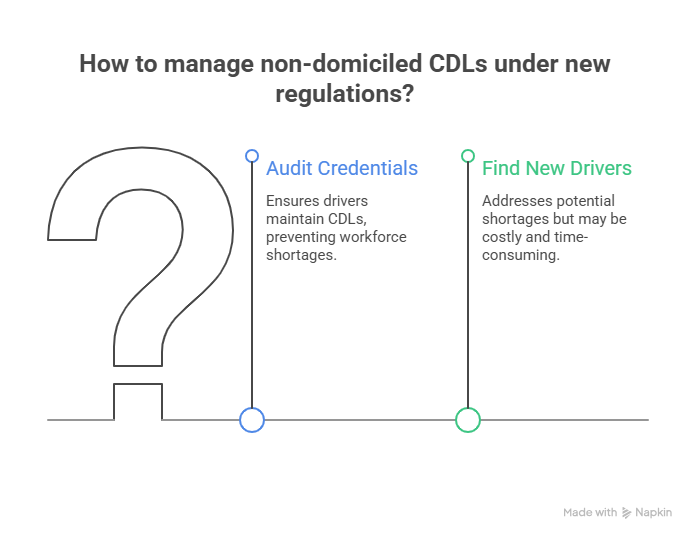
The fleets that use the services of non-domiciled drivers could simply end up being undermanned and trying to find new drivers.
The fleets that use the services of non-domiciled drivers could simply end up being undermanned and trying to find new drivers.
In your dispatch business case: you can consider auditing drivers credentials and making sure that no key drivers will lose their CDL because of this rule.
Example scenario
Consider the case of Jorge, who is an owner-operator that has been living in the U.S. since he was 2 years old and has had a CDL since the age of 11 and owns his trucking company (DACA). With the rule change, he was renewed on September 30 but was rejected due to his CDL being classified as a type of non domicile.
Key takeaways
The major keyword that we will be attempting to appeal to is FMCSA CDL rule, which can be defined as the rule change and its consequences.
The regulation is in effect and hence time is of essence to carriers and dispatchers.
Although the rule is targeted at the so-called non-domiciled CDLs, the implication on the freight/dispatch world is the ripple effect can be far reaching.
Not only in theory: actual drivers and businesses have already been affected by this – it is, in fact, time that your dispatch service should be aggressive in directions and risk prevention.
Drivers must do these things immediately.
In case of either you or one of your drivers being subject to the FMCSA CDL regulation, here is a checklist that you may and give to your clients:
Establish the fact that your CDL is non-domiciled.
State of issuance of your CDL/CLP and three years of U.S driving history in that or different state. Otherwise you can fall into the category of non-domiciled.
Verify your immigration/visa: Are you on asylum, a refugee, a DACA recipient or an Employment Authorization Document (EAD)? With the new rule most of those categories are out unless you pass the more stringent requirements.
If you’re at risk, act fast
Don’t wait. The rule is in force despite the fact that until November 28, 2025, people can still comment publicly.
Contact your DMV / state driver license agency and ensure that you are up to date. Non-compliant CDLs may be initiated through some states with non-renewal or revocation.
Make a call to your dispatch service and/or carrier. When you are holding loads or you are assigned by the dispatcher, their operations are influenced by your license status.
Document everything
Retain copies of your existing CDL, renewal alerts, letters with DMV, and any rejection or inquiry that you receive.
In case of being denied renewed due to this rule, you might have to think of the legal consultation – the suit filed ( Rivera Lujan v. According to FMCSA) the rule was not issued in accordance with due notice and comment.
Get onto other drives or contingencies.
You will be a dispatcher or fleet owner and you should ensure that you have the backup drivers who are entirely domiciled and not subject to the rule.
To risky drivers: reexamine your load roster, lanes and assignments. In case they lose their CDL, you might have to resettle loads or reorganize your dispatch plan.
To owner-operators: Begin to find alternative business models (see next section).
Stay updated
Check state-by-state reactions: not all DMVs of states interpret or enforce it alike
Monitor the result of the lawsuit and federal updates of FMCSA. The rate at which states are taking action and whether enforcement will be consistent is of close interest to the industry.
No CDL Is Not the End of the Road
This FMCSA CDL rule does not imply that you are done with your trucking career by losing or failing to renew your CDL. In your case, as a dispatch service provider and ecosystem of drivers and fleets, you have an opportunity to lead: you will be able to assist your drivers to move, shift, or seek other jobs.
Non-CDL options for drivers
Flat-bed or specialty freight which does not need CDL: In certain states and depending on the size/weight of the vehicle, drivers can drive non-CDL rigs. Types of freight that can be targeted in this category can be selected.
Logistical or dispatch support positions: Years behind the wheel drivers are often great dispatchers or load-coordinators – you might consider taking them into your business.
Last-mile delivery, regional light-truck freight: Select carriers are also offering non-CDL positions involving drawers of smaller trucks or in state lanes.
Maintenance/logistics support: Former CDL drivers also have a chance to transition into management of the fleet, load planning, safety compliance, or onsite logistics support due to their experience in working at this place.
The reason why your dispatch business is important.
You are on a good location: As a business owner of truck dispatch service, you can offer some value to drivers who would be impacted by this rule by:
- Active checking of the status of drivers and providing guidance
- Giving such drivers alternative load networks (non-CDL capable).
- Selling the fact that you provide regulatory risk management on carriers with new-authority and owners.
- Assisting small fleets to modify the lane plan when the key drivers are out of service.
Example: How you might help
Assume that one driver is affected by the rule in a small fleet of 3-trucks. With your help, you could:
- Determine the risk of the driver with the FMCSA CDL rule.
- You reassign the long-haul of the driver to another driver and you secure alternate non-CDL assignments, which the driver.
- The fleet should be adjusted in its lane strategy in the coming 90 days to prevent the costly downtime.
- Record your dispatch service as a risk-reduction partner – a selling point to new customers.
Problems with finding a non-CDL job?
Should you or one of your drivers be experiencing non-renewal or revocation under the FMCSA CDL rule and require a pivot: the following are actionable steps that may be undertaken as well as resources that can be forwarded.
Step-by-step
- Revise your resume: 5+ years experience, safety record and operations knowledge.
- Find non-CDL amenable carriers: In numerous cases, regional outfits employ a truck of fixed length 26 feet, box van, or service truck without CDL.
- Research dispatch/coordination positions: You have a leg up because of your experience driving.
- Network: It is possible to lean on the industry associations, groups, and forums where non-CDL vacancy is published.
- Use your dispatcher: As you are running non-CDL loads dispatch services you could build a database of those kinds of loads and pair them with impacted drivers -win-win!
Resources to share
Media that are reporting on the FMCSA rule and its repercussions: Land Line Magazine, Overdrive, Public Citizen (legal angle) are all trade-media reporting on the FMCSA rule.
Workforce-transition programs: The programs assist in moving drivers into the logistics-side of work include most state DOTs or trucking associations.
Job boards that have filters of non-CDL required – ensure that your clients who are drivers are paying attention.
Your value as a dispatcher
You can sell to carriers: “We can get high-paid loads to CDL drivers, and we can find a solution to non-CDL placements and backup driver networks, particularly with new regulatory risks like the FMCSA CDL rule. This raises your company to a new level of simple dispatch – it is a tactical compliance ally.
Don’t Drive Empty. Drive with Logity
When developing your trucking or dispatch firm, establish yourself as the preferred operator when it comes to owner-operators, small fleets, and new carriers struggling with new issues such as the FMCSA CDL rule. You are not only to seek loads but to make drivers remain compliant, profitable and on the move.
Emphasize your strengths:
- Active compliance assistance: Educate your carriers about the new rules of FMCSA and assist them in preventing expensive downtimes.
- Load-matching of CDL and the non-CDL drivers: Keep all your network on the road with the correct freight choices.
- Introduction of smart lane plans: Reduce empty miles and maximum disturbances due to licensing or employee turnover.
- Good contacts in the industry: Do not depend on load boards to find consistent and high-paying freight, but go directly to reputable brokers, shippers, and carriers.
Final thoughts
The FMCSA CDL rule has not been an ordinary regulatory shot in the air but a possible ground breaker to thousands of drivers, carriers and dispatchers. Knowledge of the risks, the ability to help clients overcome them, and to provide solutions to such problems in a dynamic regulatory space will make your dispatch business a reliable ally in a challenging world.