Difference between Brokers and Freight Dispatchers.
A trucking broker and a trucking dispatcher may seem to be one and the same thing, but they are not. Indeed, the knowledge of the distinction between a freight broker and a freight dispatcher can save time, money, and misunderstanding to a trucking company in the future.
Be it a new owner- operator who is trying to book his first few loads or a small fleet owner who is looking to expand, it is important to know what each of these professionals do (or do not do) in order to have a smooth and profitable operation.
We can simplify it and discuss the difference between brokers and dispatchers, their functions, the ways they earn money, their clients, and the type of relationship that they maintain with drivers and shippers.
What is a Freight Broker?
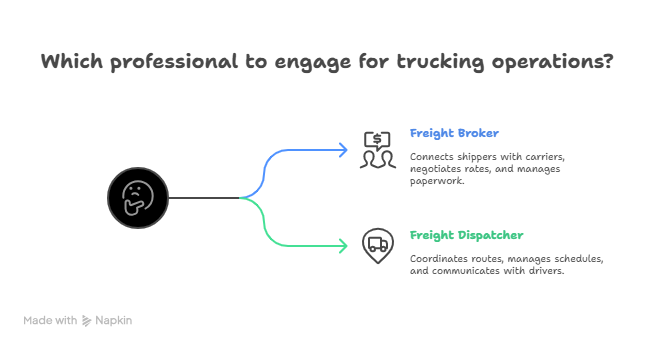
Freight broker is an intermediary between a shipper (company which requires to transport freight) and a carrier (trucking company which transports it).
Their main job? Make connections between shippers who require loads being moved and carriers who could accommodate such loads. Imagine a freight broker to be a matchmaker in the logistics sector. They are used by shippers in order to find good carriers. They depend on them to get freight that is profitable.
How Brokers Operate?
The FMCSA (Federal Motor Carrier Safety Administration) licences freight brokers. They are required to have a surety bond – normally 75,000- that serves as a sort of insurance to carriers in the event that the broker does not pay a load.
A broker is usually directly contracted with shippers. They put up the loads that are available on load boards or contact their carrier network to cover those loads. Upon confirmation of a carrier to transport the freight, the broker dispatches a rate confirmation containing all the details pickup, delivery, commodity, rate, and terms.
The broker will then invoice the shipper of the load and gives payment to the carrier after deducting a small portion to their services.
How Brokers Make Money?
The freight brokers make a commission – which is generally the margin between what they charge the shipper and what they pay to the carrier.
For example:
When the shipper rewards money $2,500 to load the ship, yet the carrier accepts to transport the ship at the cost of $2,200, the broker retains the difference as his/her fee of 300.
The model provides a high motivation to brokers to bargain favorable terms on both sides without compromising relations with the carriers as well as the shippers.
What is a Freight Dispatcher?
The freight dispatcher is not in direct contact with the shipper but the carrier or owner-operator. Their mission is to guarantee the flow of the trucks in constant motion and the largest number of profits, searching, negotiating and ordering loads.
In cases where brokers are recruited as the intermediary, dispatchers are more of the assistant to the truckers.
How Dispatchers Operate?
The dispatchers are the ones that are concerned with load boards and the brokers and sometimes deal with shippers to secure freight. Nevertheless, unlike brokers, dispatchers are not required to have an FMCSA license or bond as they are not brokering freight, they are just providing logistics services on behalf of a carrier that already has an operating authority.
A good dispatcher has a day that consists in:
- Shopping profitable loads.
- Negotiation of brokerage rates.
- Confirmation of rates and paper work.
- Providing information about pickup and delivery.
- Checking in during transit
- Arranging and controlling preferences of drivers.
The dispatchers can be independent contractors (third-party dispatch services), or as employees of a trucking company.
How Dispatchers Make Money?
The dispatchers usually charge a certain amount at the end of each week or percentage of the load rate – traditionally, this is 5 to 10 percent.
For example:
Dispatcher will charge you 8 percent on a 3,000-weight load in your truck, and he would receive $240 and you would receive 2,760.
They do not wish to earn money off the disparity between the shipper and the carrier, however, they want to provide the drivers with the best paying loads and get their trucks on the road as often as possible.
The Main distinctions between Dispatcher and Brokers.
Let’s get to the heart of it. The following are the key differences between a freight broker and a dispatcher which are presented in a manner easily digestible.
| Category | Freight Broker | Freight Dispatcher |
| Who They Work For | Shippers (companies needing freight moved) | Carriers or owner-operators (those who haul freight) |
| Main Role | Match freight between shippers and carriers | Manage loads, negotiate rates, and keep trucks running |
| FMCSA License Required? | Yes | No |
| Bond Requirement | $75,000 surety bond | Not required |
| How They Make Money | Profit margin between shipper and carrier rate | Percentage or flat fee from carrier |
| Who Pays Them | The shipper | The carrier or owner-operator |
| Focus | Building shipper relationships and capacity networks | Building carrier relationships and finding consistent freight |
| Control Over Loads | Controls which carrier gets the load | Works with broker loads or direct loads for their carrier |
In short:
- Brokers create freight opportunities.
- Dispatchers manage those opportunities.
Why the Confusion Exists?
The demarcation between brokers and dispatchers is sometimes blurred, particularly with the emergence of the independent dispatch service.
Other dispatchers are involved in too much communication with brokers and shippers that it may appear as brokering. However, dispatchers are not legally permitted to be the intermediaries between shippers and carriers unless they are brokers.
In order to remain in the compliance, dispatchers should:
- Only contract with carriers with their MC authority.
- Do not address shippers directly.
- Have a contract with the carrier to whom they send.
- Make sure the payment of the load works shipper -broker- carrier-dispatcher (through carrier).
Taken correctly, dispatchers can be a massive liability to the carriers – the pressure of making a reservation, paperwork, and negotiation of rates is completely relieved. However, when taken badly (such as brokering freight when not in charge), it may cause legal issues.
Which One Does a Carrier Need?
Such is based on your business model and level of experience.
If You’re a New Owner-Operator
Your best friend as a beginning dispatcher is a dispatcher. You do not yet have a big network of shippers and it is difficult to calculate the rates, lanes and paperwork.
A dispatcher helps you:
- Be loaded and do not make empty miles.
- Get to know the good rates in your locality.
- Negotiate and make calls with handle brokers.
- Make sure that your paperwork is clean and compliant.
- Simply put, they allow you to pay attention when driving, as opposed to making phone calls and loading boards.
In case You are a Growing Carrier or Fleet Owner.
You may begin doing business with freight brokers directly as your business expands or you may even develop direct shipper relationships.
Brokers are able to offer regular routes, better paying dedicated loads and the availability of freight that you may not be able to get on open boards.
But most successful fleets hire both: a dispatcher to run the operations and brokers to make freight linkages.
Pros of Collaborating With an excellent Dispatcher.
Then you have experienced how precious a experienced dispatcher is when you have spent hours on the phone trying to locate a load when a delivery has been made.
The following is what a good dispatcher can offer to the table:
- Rate Negotiation Skills – Dispatchers are aware of market conditions and they are not going to allow you to accept low freight.
- Time Saving– You are on the road and they on the load boards and paperwork.
- Individual Planning– They know what you want- short hauls, long routes or certain states.
- 24/7 Support – They are the one who offer their support when there is a problem in transit.
- Stable Cash Flow– Less fluctuating loads translates to less idle days.
Basically, a dispatcher acts as your own personal logistics manager who is concerned about ensuring that your business continues to make profits.
Advantages of Cooperating with a Trustworthy Broker.
Large or specialized shippers Sometimes, freight brokers are the only ones who can open the door to freight opportunities that dispatchers cannot.
Here’s what brokers offer:
- Availability of Freight Networks– They are contracted with various shippers in various industries.
- Consistent Payments The brokers are known and have good working relations with the factor and consistent payment cycles.
- Load Variety– The brokers can find your schedule full of variety; dry vans, flatbeds, reefers, etc.
- Market Stability– Brokers assist in providing even dips in the market in the off-season by providing lanes among the different regions.
- Business Growth – Reliable freight will enable the small carriers to grow into fleets quicker.
The Bottom Line: Dispatchers and Brokers are Not Rivals -They are partners.
It is easy to believe that dispatchers and brokers are the antagonists of each other, however, the reality is that they are complements.
Brokers rely on dispatchers to get in touch with trustworthy carriers who would deliver freight within the timeframe. Brokers help dispatchers to find regular freight to their drivers.
The two are important in the trucking ecosystem. The major distinction is in their service and payment.
As a carrier or owner-operator, you can have the best of both worlds, another trusted dispatcher and reputable brokers, to enable you to have steady loads, good rates, and less downtime.


One Response